Wednesday, 30 March 2022

HelpHound - why it is the only option for professional businesses

In spite of our fifteen+ years of experience working - full time - with reviews, our exhaustive knowledge of Google and the likes of Trustpilot, Yelp, Feefo, Reviews.io, TripAdvisor, Reputation.com and the rest, and - even more puzzling - the amazing case histories (link in the first paragraph of 'Do reviews drive revenue?' below) we still, frequently enough to have us write this article, encounter responses along the lines of 'No, we are doing [insert current ineffective or often downright illegal strategy] and we're going to stick with it.'

We know it's only human to be defensive when you have invested time, energy and resources into a solution, even if that solution can be proven to be deficient (remember just how many people persisted in buying Vauxhalls or Lancias back in the day when the whole world - from friends to the motoring press - was telling them, time and again, that they would be driving a worthless rust-bucket in a few years' time?).

The role of this article is to calmly work through the solutions that don't work or are likely to endanger a business's reputation - or are just plain illegal, so you can make a rational and reasoned decision for your business.


First: do reviews drive revenue?

If you have already experienced the power of positive reviews to drive up clicks and calls then skip this section and begin again at 'Benefits are measurable'. 

With well over 90% of consumers consulting reviews before they purchase a product or service, reviews - and professional review management - are not a 'cost'. They are most definitely a profit-generator - for those businesses that are prepared to put in the effort and overcome the 'fear'. 

A business scoring over 4.5 on Google with over 100 reviews will attract more clicks and calls than a business scoring less with fewer reviews. Read these case histories and you will see exactly what we mean. Great reviews and great scores lead directly to...

  • increases in enquiries, both through a business's website (providing reviews are hosted and shown there) and through Google. This can easily be quantified by reference to the business's Google My Business monthly report which will show you the uplift in clicks and phone calls through Google search. 
  • greatly enhanced SEO: we are constantly asked 'How does XYZ HelpHound client consistently appear at or near the top in any given Google search?' The answer is complex and shrouded in mystery (it's Google's 'Coke formula'), but Google tells us that it gives significant SEO credit to businesses that host reviews - proper reviews, not testimonials - on their own websites.


Benefits that are measurable

Cost - as we all know - is only relevant when viewed in the context of benefit. Fortunately, Google sends every business on the planet a monthly report that tells it exactly how many enquiries - click-throughs and phone calls - it has had as a result of Google searches in the last month. Again, here's a complete article on results here, but this screenshot of a business's uplift in both clicks and calls after joining HelpHound really says it all...
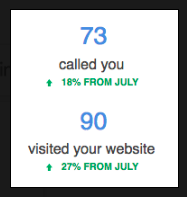


18 per cent more calls and 27% more clicks for less than £200 a month (much less if you have multiple branches)? 


Now on to the various solutions available to businesses...

Google - direct

Great. Spot on. Google reviews are it. Way ahead of anyone else's. Unless your business is vulnerable to the occasional inaccurate or misleading review. The business world is divided into three categories...

  • those that are impervious to online reviews: the likes of your mobile phone provider, utility companies or banks. They'll carry on trading irrespective. Here's an example we all know of...


Ticketmaster is just about as impervious to negative reviews as a business could be 

  • those where the business - often selling products as opposed to services - recognises that it needs to score 4 out of 5, but that's enough. Online retail is a good example: if someone is buying a shirt and it scores 4 out or 5 they will still buy it. Less than 4 and they will probably look for a better rated product.


Boden will no doubt shrug at a score of 3.0 on Trustpilot. A similar score for a doctor or a solicitor on Google would almost certainly close them down, from the point-of-view of search-generated business anyway

  • Professional services, where consumers are looking for as close to perfection as is reasonable. We know, from hard experience over many years, that a Google score of over 4.5 is crucial for the likes of medical, financial, legal or 'large ticket' services - estate agency being another obvious example. Please read the following review carefully...


This law firm had enough evidence to convince a judge to make a five-figure damages award as a result of the impact of this single negative review. 

And their image on Google must be doing them significant harm as well...


Just look at this single critical review on Google:


And now note just how many people have voted it 'helpful'


Note for those still thinking 'negative reviews can't harm my business': The five figure award was made because the firm of solicitors were able to provide concrete proof of declines in both telephone enquiries and clicks though to their website subsequent to the publication of the critical review on Trustpilot sufficient to convince a judge sitting in an English court of the fall in revenue it had experienced. Given that Trustpilot reviews are only visible to those actively searching for them and Google reviews are seen by just about anyone searching for the business in question we don't feel that we are exaggerating in saying that a negative review on Goggle is going to do at least ten times the damage that a similar review on Trustpilot has been proven - to a court's satisfaction - to have been done here. The full story is here.


Businesses in the last category - professional and services -  need to combine Google reviews with a moderated system whereby the client or patient is first invited to post the review to the business's own website, where it can be checked for factual inaccuracies or the potential to mislead pre-publication; only then is the reviewer asked to copy their review to Google. It is also nice to know that this helps with SEO and ranking in local search. 

Breaking the law

This is the biggie: most businesses don't understand the UK law as it relates and applies to reviews and those that do misunderstand the consequences of breaching it.

The law

Is quite straightforward: the following three actions are expressly forbidden...

    • selectively inviting customers to write a review. Any business proactively inviting reviews must be able to prove that any customer is able to write a review at any time of their choosing
    • showing selected reviews on the business's website
    • 'gating': using a mechanism - which might be a 'customer survey' or another less visible review site - to establish which customers are most likely to write a positive review and then inviting only those to do so

        The consequences

    • the less obvious, but potentially just as harmful: the fact that any of the three illegal activities listed above will be obvious to any savvy competitor; they are then almost certain to use that information in competitive pitches 'Yes, their reviews are wonderful aren't they? But we're bound to tell you they are that way because they are illegally acquired/filtered. Do you really want to be dealing with a business that flouts the law?'
    • and in the case of gating: this is expressly against Google's Terms of Service as well. Google will simply delete all the reviews of any business it considers to be gating. And there will be no appeal


Review sites


The fact that Trustpilot's share price is now over 70 percent down from its peak of 449p in only six months (against a market that has risen 6%) shows just what investment professionals think of its prospects. By deflecting client businesses' efforts away from Google it is doing them a long-term disservice.

This article was published here on our blog four years ago. And it wasn't the first time we warned businesses against using, let alone paying for, a review site. The review site gets all your lovely client data in exchange for what? Giving you a star rating that's far less credible or influential than a free Google one.

Yet we see them everywhere. How so? Simply because they predate Google reviews (there would have been no review sites if Google hadn't been so late to see the power of reviews). Also: they have salesforces who are trained to maximise the wafer-thin benefits of these sites and minimise the power of Google reviews. But just perform any simple search - on your own business or any other - and what do you see?

Google reviews. End of.

So: if your business falls into the first two categories you just need a Google widget on your website and then invite customers to post directly to Google.

If you are a professional or service business you will need a moderated but Google-focussed system that gets reviews - your own - to your own website and then get as many as possible of those across to Google. Like this...


240 here, then...


...151 to Google (note the extracts appearing in the Google rich snippets at bottom right and the original reviews hosted on their own website showing alongside their organic listing at top left). Then the all important local search...


...where they lead both the Google 3-pack and natural (organic) search.  

Review aggregators

What a great idea. What could possibly go wrong? For clarity, review aggregators scour the web for any reviews of your business and then present them on your website for potential customers to see. Fine, until you realise that there's no safety net. No way of moderating what is being written or said before it's published front and centre. That's fine if you are an online retailer and people are looking for you to score 4 out of 5 before they order your shirts or socks (one review site was even founded by such a business) but potentially hugely damaging for a professional business providing easily misunderstood complex services to clients or patients.


We wonder just how long before this one-star review - fed through by an aggregator - was noticed by the business? All we do know is the business in question is no longer using the aggregator.

And another...


We stress that both these screenshots were taken from the front page of each business's own website. And guess what? They're no longer there. Review aggregators don't work for high value and/or complex service and professional businesses.


Time and human resources

When we speak to our clients they tell us that once they have embedded review management into their daily routines they simply don't notice the time taken to look as good as they do. Most mention the fact that they find the exercise hugely rewarding from a management and staff morale point-of-view. And when they have experiences such as this...


...any thought of time or effort vanishes into thin air.


In conclusion...

If your business falls into any of the following categories:

  1. Yet to actively engage with online reviews - from fear of the consequences or just because you have been meaning to but just haven't got around to it.
  2. Engaged in the past but had a negative experience - a harmful review on Google or any other site, for example.
  3. Already inviting clients* to post direct to Google but are aware of the risks that this entails.
  4. Already inviting clients* to post to a review site, but concerned that you may be missing out on the power and credibility of Google reviews.
  5. Cherry-picking or gating - sometimes euphemistically called 'selecting' and 'pre-qualifying' but nonetheless illegal - to ensure your online reputation is protected (don't worry, you're not the only ones, but you will sleep a whole lot easier once you have adopted a legally compliant solution).
You owe it to yourself and your business to, at the very least, take the first step in the direction of a professionally managed review system; call us and we'll talk you through all the implications for your business** and answer all your questions


*Note 1: we use the term 'clients' here advisedly. If your business has 'customers' and you sell those customers 'products' - as opposed to some kind of service, be it financial, medical or legal (or a hybrid of those such as estate agency or recruitment) - we will still be able to add value, but HelpHound was specifically designed to enable professional and service businesses to enage - compliantly - with reviews.

**Note 2: each business is different, and therefore each solution must be tailored. Review sites tend to operate on a 'one widget suits all' basis. They also tend to be 'sales heavy' and light on ongoing customer service: something that we at HelpHound pride ourselves on.

Our objective is to only have clients where we can add value - right to their bottom lines - so we have no incentive at all to take on a business where we are unable to do that.

Monday, 7 March 2022

Trustpilot: yet another question


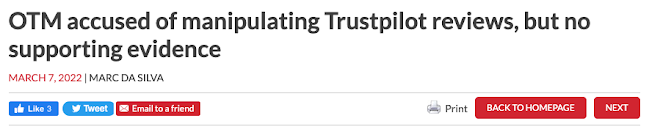
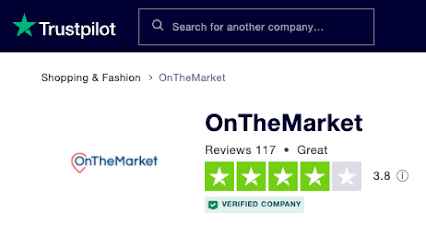
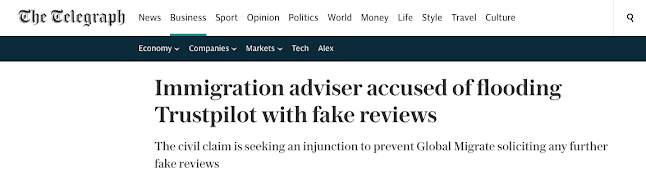
This article appeared today. So we had a look at the listing it refers to:


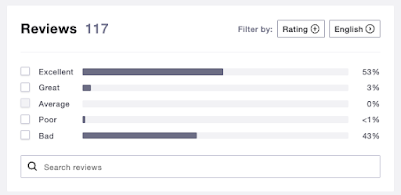
And then we checked the underlying reviews by score:


Which raised a wholly different question: how on earth does a business that has 43 percent of its reviews scoring 'Bad' (rated the lowest: one star) get a 4-star rating from Trustpilot with the accompanying accolade of 'Great'?

What we can tell you is that based on the spread of reviews shown above, both HelpHound and Google would score the business at 3.2, giving a Trustpilot rating of 'Average'. 

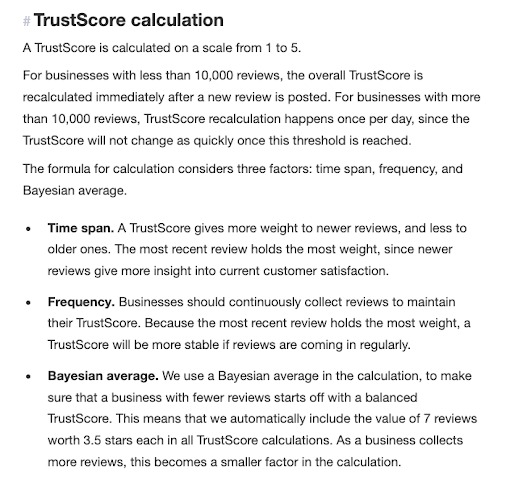
Trustpilot, in their explanation of their scoring system state as follows:


We would comment on each of these bullet points:

  • Weighting more recent reviews. We would recommend that any review system that is going to stray from an unweighted mathematical calculation completely discount reviews that are over three years old; part of the point of reviews is that businesses should learn from them and therefore consumers should be given a snapshot of the business as it currently is, not skewed by ancient reviews. In the case of OnTheMarket, they have received 11 five-star reviews and 8 one-star reviews since 1 January 2022; any 'weighting' would struggle to find a positive outcome from those stats.
  • Frequency. We have no argument in principle, but the basis of calculation or weighting should be clear. We have no clue what the sentence 'Because the most recent review holds more weight, a TrustScore will be more stable if reviews are coming in regularly.' means.
  • Bayesian average. Fortuitously one of our directors used to work at HM Treasury and so is familiar with Bayesian averages. He has explained that these are usually used to smooth statistical subsets; he says that the application of a Bayesian average cannot explain why a business that should be scoring 3.2 might suddenly score 3.8. For those of a mathematical bent here is the Wikipedia entry for Bayesian averages.

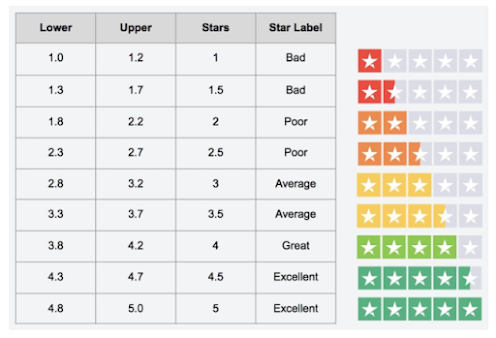
Here's their star rating and 'Excellent/Great/Good/Average/Poor/Bad' matrix:


Which illustrates the difficulty - for the consumer - inherent in such a system. Any business scoring in the range 3.8 - 4.2 is 'labelled' 'Great'. Seriously? Such a business is likely to be rated at 1* by at least twenty percent of its customers (Bayesian average or not). Would you use a doctor/lawyer/financial adviser where one in five of their customers rated them one star, bearing in mind a business cannot be rated 0 stars?

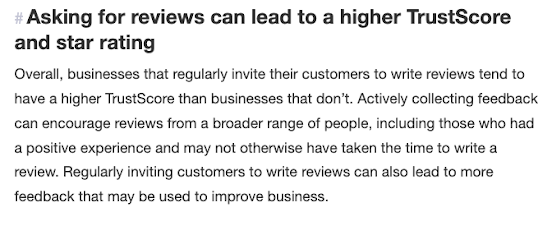
Last, but not least, this:


We have no argument with the last line, but the rest? Really? Well, yes, in the case of Trustpilot. Businesses paying Trustpilot do score better than those that don't. But that's the same with any review system - businesses that are passive invariably pick up 1* reviews from unhappy customers as they are so much more motivated. HelpHound clients invariably score 4.5+ but that's because they are excellent businesses with dedicated CRM. But, as all our regular readers know, we advise our clients to focus their efforts on their own websites and Google - in other words, where their reviews will be seen.


In Conclusion

It's best to let consumers read reviews and make up their own minds, by reading the individual reviews in conjunction with an 'unmanipulated' score, as to whether the business is good or not.

Wednesday, 16 February 2022

Trustpilot sues a business for posting fake reviews


The last time Trustpilot took action against a business it was for the business in question suing - successfully - a Trustpilot reviewer/customer (there's an excellent article by a qualified solictor here and our own analysis of the action and impact here). Trustpilot suspended law firm Summerfield Browne's listing in February last year and it remains suspended as we write; no more reviews, frozen in time, but still appearing on Trustpilot's website, over a year later


And goodness knows how many times that 1* review has been seen since (it's obviously written by the person in the lawsuit); it's been voted 'useful' 145 times - and we use a 1:20 rule of thumb - if one person votes for a review, you can be sure at least another 19 have read it, so that makes another 2,755 people who were looking for a solicitor who may well have been put off contacting the firm by this review).

We're not sure how fair this is, on the law firm or on consumers. 

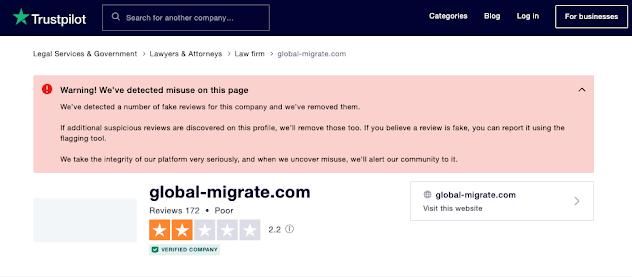
But back to the latest case. here's what the business's Trustpilot listing looks like today:


We have some questions for Trustpilot:

  1. How did they identify the fake reviews?
  2. How did they decide which reviews to delete and which should remain?
  3. Why have they not suspended the business's account in the same way as they have suspended Summerfield Browne's?
  4. How do they propose to prove that the business is 'soliciting fake reviews'?
That answer to that last question will be interesting. We often see what we suspect to be fake reviews, all over the web, but 'suspecting' and 'proving in a court of law' are vastly different matters.

We will be following this story closely. And we'll report to you when we har anything more. Meanwhile, our advice to you all remains the same: focus on Google, get Google reviews compliantly (don't cherry-pick or gate) and build your reputation there, where all your potential customers are looking, not on review sites.

Why not Google?

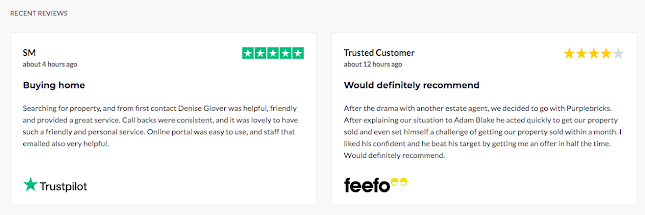
 Here is a well-known and much-marketed national brand, on its own website:


Now, given that we all know that Google reviews are:

  • more visible - in all searches
  • more viewed by consumers
  • more credible - at least Google knows the online activity of the reviewer
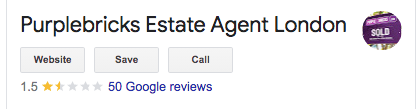
Why are they not promoting their Google reviews? Maybe the answer is here, in searches on their HQ...


...and London:


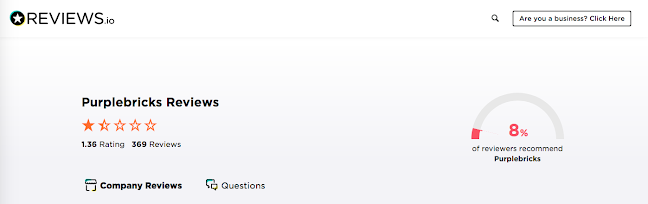
And here, with the second organic result when a potential customer searches for 'Purplebricks reviews':


Ouch! Three times ouch!

Now, we are not commenting on the effectiveness of the business. We've never used them. But we are commenting on the effectiveness of their review management strategy; it is misguided.

Why?

At the very least, employing not one but two review sites - why two, we have been asking ourselves and our readers for years? - has led unhappy customers to ignore the business's chosen channels and write their reviews to Google (and another review site). This is a well-known habit we christened 'deflection' (this article was written over 5 years ago).

Lessons for them - and everyone else

First and foremost: a business's review strategy should be based on and built around Google reviews, not any of the independent sites.

Next, if you run a complex service business such as an estate agency - or a financial, medical or legal practice, where your good reputation is a vital plank of your marketing* - you need an independently moderated system. This will ensure the bare minimum of inaccurate, misleading or just plain unfair reviews see the light of day.

Having accepted those two basic ingredients you will need to find someone like HelpHound so you can host your own reviews on your own website and have them moderated and as many as possible copied across to Google.

Back to the original question: why have Purplebricks not adopted such a strategy? We haven't the faintest idea. Please comment if you have.


The City knows what it's doing

Not always. But in this case it looks as if it does:


* 'Isn't every business's online reputation important?', we hear you ask, quite sensibly. Well no. High Street retail and quasi-monopoly businesses such as utilities will trade quite happily while their customers rate them 1* online. Think Starbucks or Vodafone. Definitively not the case for a solicitor or a gynaecologist - they have to look the best they possibly can; if you have any doubts at all please read this horrifying case history.


Friday, 11 February 2022

Reviews drive revenue

It's that simple: when a business gets its review management right it should expect it to pay significant financial dividends (more below).  But there are four key rules that all businesses need to follow if reviews are to drive revenue without compromising the business's legal integrity and its ultimate long-term reputation. They're all straightforward, but 'break' one of the four and your review management will ultimately* fail.

*Ultimately: far too many businesses have either taken a short-term view on Google reviews - get as many as possible, all positive, irrespective of the law - or they have been sold a solution that will ultimately result in harm to their brand, often by diverting reviews away from Google to a review site, where their reviews are increasingly invisible to their prospective customers. 

Marketers need to be planning at least a decade ahead where review management is concerned and should be able to answer the question 'Where do we want to be with regard to reviews and what impression do we want to be creating in 3, 5, 7 and 10 years time?' with confidence.


Rule 1

Obey the law. 


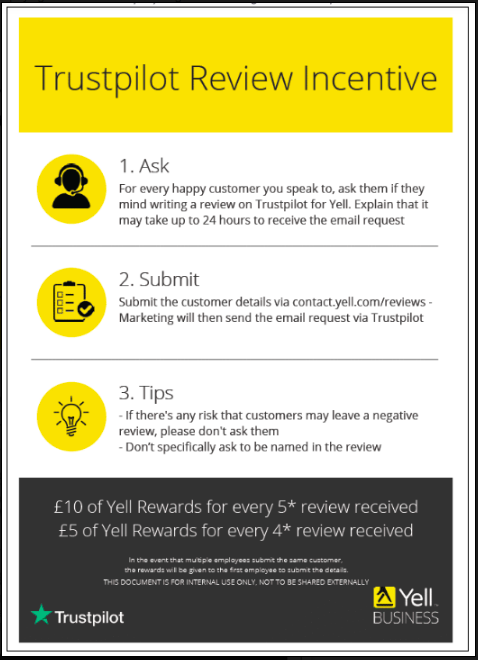
It is rare to come across such hard evidence as Points 1. and 3. on this Trustpilot/Yell notice to staff, But we estimate that well over 50% of businesses have some such demonstrably illegal scheme in place, whether focussed on Google or a review site (or both).  The CMA has powers to confiscate computer equipment and email records, and it will use them. And if you knew a competitor was doing this?


Very few businesses currently do - obey the law, that is. There's a simple test: if a business does any of the following...

    1. Invites selected customers to write reviews
    2. Controls the timing of the review
    3. Rewards staff for attracting positive reviews
    4. Rewards customers for posting reviews
    5. In any other way 'filters' customers to eliminate those less likely to write a favourable review

...then the business is not compliant with the CMA rules or UK law.

In addition, if the business pre-qualifies those it wishes to invite to post a review to Google, a practice known as gating, it will be in breach of Google's terms of business (customer surveys are a popular mechanism here). If found to be doing so by Google the business will have all its Google reviews deleted without recourse to appeal.

The single most frequent reason given for this non-compliance is 'but our competitors do the same.'  No defence, obviously.


So: in order to obey the law and be confident of protecting its hard-won reputation a businesses must find a solution that allows all of their customers and other stakeholders* to write a review direct to it rather than straight to Google. It must then publish all those reviews on its own website (having had them moderated - see Rule 2 below), and then have as many of those as is practicably possible copied by the reviewer across to Google.

*other stakeholders: it is a common misconception to assume only paying customers will write a review to Google; we estimate that up to 20% of negative reviews are written by people where the experience they are reporting happened before any financial transaction took place, (think of the disappointed potential tenant or failed purchaser of a property - or the classic example of the prospective patient frustrated by their dealings with the doctor's receptionist). It is important that businesses give such people a route to vent their dissatisfaction before they resort to Google.


Rule 2

Adopt a moderated solution. 


 This single review, on a review site with far less visibility than Google reviews, caused enquiries to the business in question - a firm of solicitors - to drop by over 40% overnight. Here's a link to the full case history including the judge's summary of findings in the subsequent court case and an analysis of the financial impact on the business which led to the award of damages


We often meet businesses that are sanguine about the possibility of attracting damaging negative reviews, until they actually receive one. Moderation cannot eliminate inaccurate, misleading or even plain fake reviews but it will go a long way - as far as is possible in today's review and compliance environment - in doing so. If you ask any one of our clients about their experience with review management they will invariably rank moderation in the top two advantages, alongside the positive impact on revenue flows that is the object of this article (see below). Moderation eliminates the fear of the negative consequences of compliance.

So: be aware that a single well-written but factually inaccurate or potentially misleading review can do significant harm to business flows. Far better allow dissatisfied or disgruntled customers to post a review to your own website where it will be subject to moderation than simply hope they won't post direct to Google.


Rule 3

Host your own reviews on your own site. 

Yours, not Google's or any other review site's. Why? Because by inviting reviews to your own site you will achieve the following...

    • you will be able to have them independently moderated pre-publication. It's the only way to prevent factually inaccurate and/or misleading reviews appearing there and on Google
    • You will be giving potential customers who visit your site, and may have missed or bypassed your glowing reviews on Google, a reassuring point-of-reference that almost all savvy consumers actively seek out these days
    • You will own your own reviews: they are a valuable asset and you should not be giving that asset away unless the circumstances are exceptional - getting the reviews across to Google qualifies as 'exceptional'; having reviews on a site like Yelp, Trustpilot or Feefo does not

So: Allow customers to post reviews direct to your own website; then have them independently moderated and invite the reviewer to copy the review to Google (HelpHound's software sends this invitation automatically).


Rule 4

Embed that solution throughout the business and all its processes.

Review management needs to become part and parcel of the daily routine of your business, alongside all your other sales and marketing practices and CRM. 

Review management is no longer a 'nice to have' add-on. It has to be core. Ask the key question: do we want to be the first of our competitors to see the benefits of professional review management or the last? Engage all management and staff and ensure review flows, to both your own website and Google, are constant and consistent. Invite reviews on your website, invite reviews by email, tell customers in face-to-face contacts that they will be invited to write a review.

So: test it; proof of concept is a challenge we relish. Any respectable solution won't tie your business in or cost a fortune (HelpHound has no contract periods - and a client once said 'it's a round of coffees on the last Friday of the month' which is an apt a cost analogy as any). Use all the resources and experience a service* like HelpHound can provide to maximise results. And monitor those results carefully - through your monthly Google My Business report, website metrics and staff feedback.

*service: most review solutions are purely software driven: the sales person is the last point of human contact; at HelpHound the sale is just the beginning of our contact with your business. Our most successful clients are often those that pick up the phone to us the most.


Driving revenue

If you obey these four rules your review management will not only become immediately compliant with UK law, it will have a rapid and sustained impact upon your inbound enquiries, through Google search and through your own website...


Just one example of a company's Google My Business report from the month after full implementation: we have seen these numbers - the percentage rises in calls and website visits - go as high as three figures


...and will then go a long way to providing the kind of support described by this customer when acting as an aid to conversion in the sales environment:


In summary


Your business has nothing to lose, and everything to gain from partnering with HelpHound...
    • more leads through Google - quantifiably
    • more leads through your own website - quantifiably
    • enhanced SEO - Google gives you credit in local search rankings for hosting reviews
    • the reassurance of employing a moderated solution
    • the reassurance of employing a compliant solution
    • excellent support in the close - from both your score and individual reviews
    • a constant flow of wonderful marketing and PR material
    • a boost for staff morale
...all with no contract period.


Further reading

  • Review denial: not yet engaged - or even consciously decided against engaging with reviews? This is a must-read article
  • Going it alone - inviting reviews to Google: why this is a high-risk long-term strategy
  • Review sites: the likes of Yelp, Trustpilot and Feefo have now been overtaken by moderated Google review solutions: far more visibility, more credibility and with a far longer shelf life. It's also now recognised as best practice to own your own reviews - don't give them, and their value, away to a review site
  • Results: expanding upon the 'Driving revenue' section above
  • Benefits: a post from which this article was distilled, including screenshots of client websites and Google searches
  • Index for 2022: this blog, running as it does for over ten years, contains nearly 1,000 articles - it can be interesting to jump back five years or more to see if our advice then was correct! -  but the articles in this index are the ones that potential clients will benefit from reading the most

Wednesday, 2 February 2022

Google Guaranteed - a contradiction?


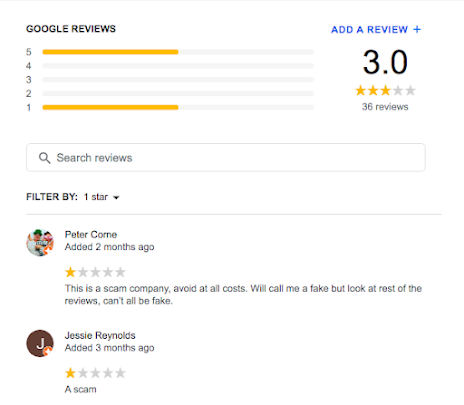
Our reaction? Simply put: then just about any business at all! Before we go on to give you a real-life example of the kind of business that scores 3.0 perhaps we should remind everyone that a consumer cannot score a business 'no stars' on Google. So, even if they consider they were robbed blind they still have to score the business one star if they are to write a review. 

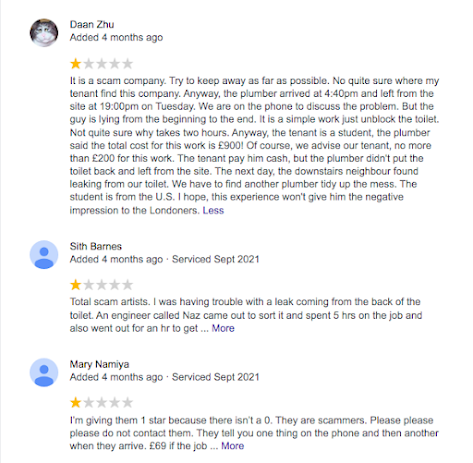
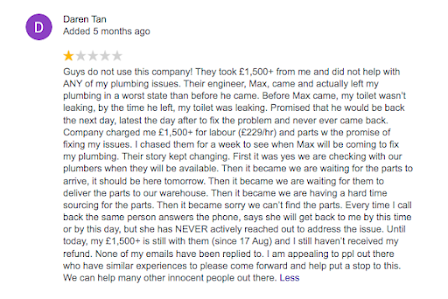
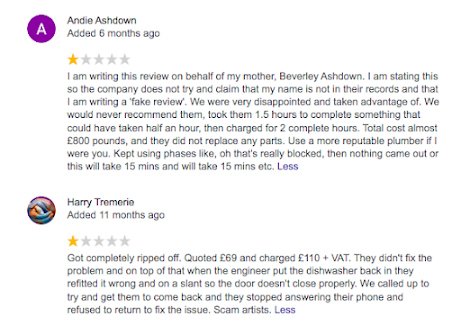
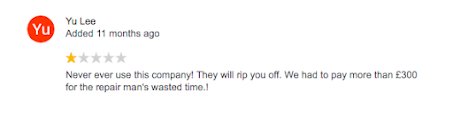
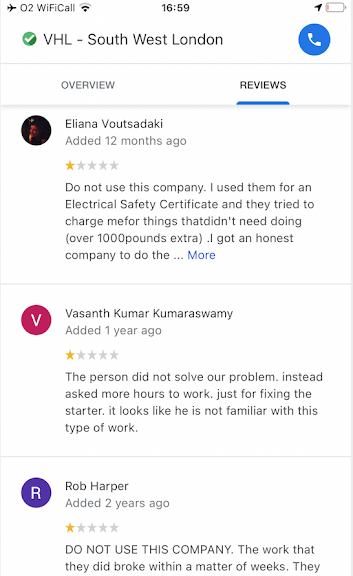
This means, mathematically speaking, that a business such as the one below scoring 3.0 from 36 reviews has 18 one-star reviews which still contribute eighteen 'points' to their overall review score. So what does a three-star business look like? Well, here are some of a 3-star plumber's one-star reviews (in fact: all of those that show on its Google Local Ads listing, where the other nine are we don't know - we only know they exist because the bar chart below shows half of the 36 reviews scoring 1*)...


And here's their shiny green Google Guaranteed tick...


The big question - and one that we have as yet been unable to unearth the answer to, despite many hours of searching - is 'Just how many Google Guaranteed claims have Google paid out on?'

Here, from Google's own website, are the terms of the Guarantee.


Our concern is that Google users will take the Guarantee at face value: that the work performed by the business will be guaranteed, albeit up to a ceiling of £1500, and, more importantly, that the Guarantee implies a certain level of expertise on behalf of the business and its employees/agents. 

Businesses such as the one above have certainly adopted it - at a cost of £500 a year and c. £25 a lead - with alacrity.

We will continue to monitor this with interest. Meanwhile, our advice to businesses is to keep on inviting reviews to your own websites, get them moderated there and then as many as possible onwards to Google, whether you choose to subscribe to Google Local Ads and the Guarantee or not.

Monday, 31 January 2022

Google Local Ads and the Google Guarantee - a moneyspinner for Google and the death knell for review sites?

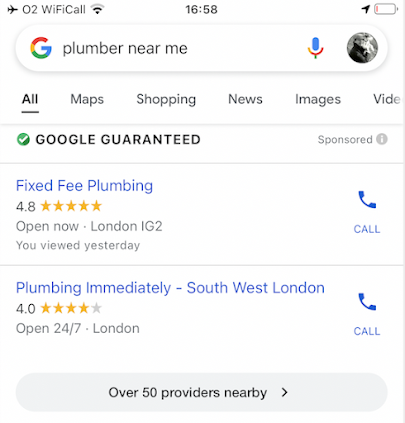
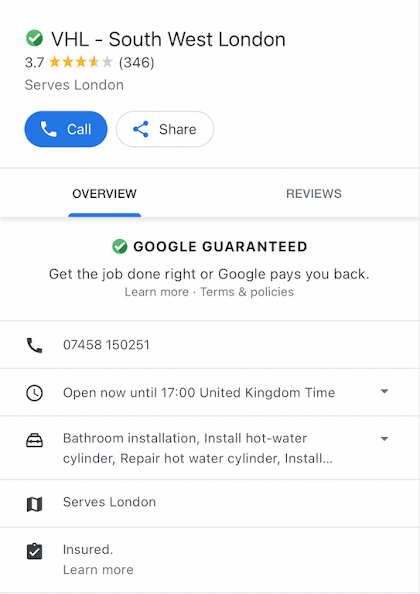
Anyone who has conducted a local search recently will have seen Google's clever new offering: here's a common enough example:


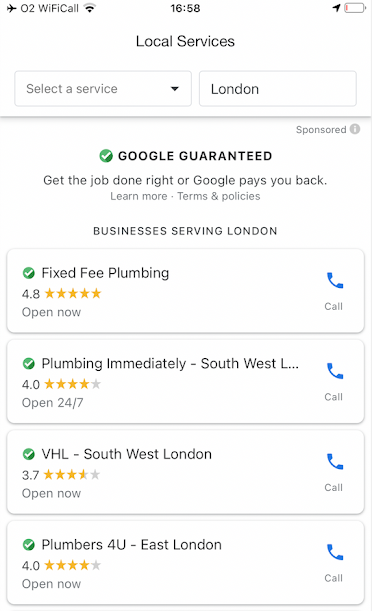
With the tab at the bottom leading to...


With the green tick that means 'Google Guaranteed'...


Although the 'guarantee' provided by Google certainly doesn't relate to the quality of the workmanship or service on offer, if some of the reviews for the Google Guaranteed businesses are anything to go by...


...these go on for a long way

The basic premise is to be found here, but to summarise: the green tick means the business actually exists plus a few other knobs and whistles (we're disappointed they will accept businesses with only a mobile number), which we suppose is a step in the right direction when you think of some of the 'businesses' doing the rounds offering their services from the back of a white van.

But there are two serious issues at play here.

First, why, if Google reviews worked and businesses engaged with them in a legally compliant manner, is this service needed? Who needs it? Consumers? Why not just search for a plumber with a decent score and a good number of reviews? Google is charging businesses for that green tick and for the ability to appear right at the top of search, above ads, above the 3-pack and above organic listings. Isn't that why Yelp quit the UK and the EU? Didn't the authorities have issues with businesses paying to be bumped up the search rankings?

Second: that's it for the likes of Trustpilot. Why would any business pay for them when they can pay Google - per lead - and appear way higher in search as well?

Answers on a postcard, please.

Meanwhile, we record Trustpilot's share price here, just out of interest, so we can refer back in the months and years to come: