Thursday, 7 September 2023

Review Management - a Guide for PR, Advertising and Marketing agencies

You know that an outstanding presence in Google reviews is a must-have for all of your clients; you also know that achieving that - a score of 4.8+ and 200+ reviews - is easier said than done, especially while maintaining compliance with the CMA regulations. What follows is a step-by-step guide to achieving this for them without running any risks - of attracting adverse reviews or of breaking the law.

This article is intended as a reference point for agencies to decide how best to advise all of their clients, whatever their current situation.


And if you haven't time to read the whole article, just scroll down to the final paragraph: 'So - after all of the above - are there any other benefits for our agency?' and you will see a precis. But we strongly recommend you follow the 'Bezos principle' (see video above) and read what follows - we promise it will reward the effort.

Note for readers

It is so easy to promote a 'one size fits all solution' to reviews, after all, that's what the review sites do. But businesses differ, not only in the way they market their products and services - see what we did? There are two distinct categories of business already! - but in the way they have historically approached (or avoided approaching) reviews.

In this article we are going to address review management from two distinct perspectives: the type of business and the current situation each business finds itself in. All of your clients - and, indeed, your own business - will be in one of the following 4 categories. For the purposes of this exercise we are going to ignore those in 1, 2b, 3 and 4 (you will understand why as you read on). For those in category 2a we will further break them down by their current status with regard to reviews and follow that with specific relevant advice.

Then it is over to you. Speak to us and we'll arrange a mutually beneficial approach to those of your clients you feel we can help. That will usually mean starting out with an individual review audit* and then progress to providing definitive tailored advice. And it will end with your client scoring 4.8+ with three figures of reviews, a great SEO kicker and in full compliance with UK law. 

As you read this article you will see continuous references to both compliance and moderation, each one hyperlinked to a full explanation. They are the two underlying planks of effective review management, so we make no apolgy for repetition.You can read them now or as you read on, the choice is yours. 

* A review audit - as the name implies, begins with examining every aspect of a business's experience with reviews to date and ending with a summary of advice and recommendations. Covering the likes of existing presence on review sites - Google/Trustpilot/Feefo/Yelp/Reviews.io and so on - and compliance with the UK government (CMA) regulations, as well as providing a roadmap to effective and compliant review management for the future.


First: the 'type of business'...

Almost every one of the UK's 5.5 million businesses falls into one of four categories...

1.  Product-based - retail in the main. Broad-brush we know, but most people will buy a pair of shoes or a dishwasher irrespective of the service element involved in their purchase. Otherwise, such businesses are served by the commercial review sites (oddly, rarely by Google reviews) - just see any online retailer's website or advertising.

2a.  Service-based - the professions and high-value transactional businesses: medical, legal, financial, educational and the like (estate agency is a good example - a service business that is infrequently used but where the consumer is aware that the wrong choice may potentially cost them many thousands of pounds) as well as 2b. Trades - plumbers, electricians, and so on.

3.  A hybrid of the above two categories - car dealerships for example - they 'sell' cars and 'service' them (We know, but we want to make quite sure there are no misunderstandings given what is to come later). 

4.  'Impervious' businesses - utilities and transport companies are two obvious examples: where the consumer either has no choice at all (South West Water or a train from Paddington to Bristol anyone?) or the business is so massive that, often despite protestations to the contrary, it really doesn't care what people are saying online (it's easy to tell: they don't repond to customers' Google reviews, when it's free and easy to do so). 

Now something about HelpHound. In an ideal world, we would welcome clients from any of these four categories, but years of experience have taught us to concentrate all our efforts on Category 2a: the professions and service-based businesses. And there is absolutely no doubt that it is in that sector that HelpHound can add the most value - in pure £££s as well as in many other ways.


Why would HelpHound effectively ignore the other three categories?

We can add value for any business, whatever its nature, but...

Category 1: After all they love reviews, don't they? Yes, they do, and the review sites - Yelp, Trustpilot, Feefo, Reviews.io, etc. - have targeted them very effectively. They would do better with professional review management, but we can add more value for other kinds of business.


As long as they score 4.0 they're generally pretty happy.


Category 2b: Trades and  'man+van' businesses, which often don't have dedicated business premises - needed for a Google profile - are covered by the likes of Which? and lead-generator businesses such as Checkatrade and TrustedPeople.


Category 3: Businesses, where the major earner is sales, and service is sometimes even a loss-leader, tend to focus on in-house reporting rather than reviews. They shouldn't, but they do. We'll be here for them when they come around.


Category 4: 'Impervious'. Well, they must be - why otherwise do they make next to no attempt to address - or even respond to - reviews from their customers (we'll repeat it - it's free!)?


So, we are left, happily, with 2a. The professions - medical, legal, educational, and financial as well as the likes of recruitment, estate agency, and so on. Most of these businesses really care about their images online...


\
We make no apology for using a HelpHound client to illustrate this category. When this business adopted HelpHound they had just 2 Google reviews!

  • it knew that scoring 4.9 on Google would drive business through its doors
  • it knew that a Google score of less than 4.5 would hinder their new business efforts
  • it knew that everything else being equal, numbers of reviews matter
  • it knew that its work is complex and often misunderstood
  • it knew exactly how harmful a well-written but factually inaccurate review can be
  • it knew that hosting their own client/patient/customer reviews gives them valuable feedback and data
And - once they understand the CMA regulations...
  • it is very pleased that it is in full compliance with UK law

Now to the sub-categories of 2a

You may be surprised to read that there are very few businesses in 2a that have adopted the correct solution. Here we go (you should be able to allocate one of the following descriptions - A to G - to each of your clients)...


A - No reviews

Still regularly encountered. Reason: almost always fear, with a capital 'F'. And that fear is fully justified: if a business provides complex and difficult to comprehend services there will be a proportion of people who will grab the wrong end of the stick with both hands and then be tempted to beat the business with it. And these days that stick - which used to be a relatively harmless 'green ink' letter or an angry phone call - is invariably a 1* Google review. 

The fatal flaw in the 'Don't engage with reviews' strategy is that it put's the business's image way beyond the its control. We used to encounter hotels that had 'no review' contracts for airline staff staying - that didn't last when the same staff realised that all they had to do was create a new Google account and fire away! One day one such unhappy customer will find their way to writing a Google review.  Best have 100 5* reviews there when they do. Even better still, have their review directed to your business where it will benefit from HelpHound's moderation.

It's the very reason we invented moderation. Moderation gives businesses of all kinds the confidence they need to compliantly invite reviews from all their customers. The alternative - crossing fingers and toes in the hope that unhappy consumers don't write reviews - may have worked ten years ago, but it's far too high risk a strategy in 2023.


B - Few reviews - less than 50 - and a high score (4.6 and up)

Often the result of at first engaging and then stalling: the engagement is often prompted by receiving a one-star review - 'let's squash that one!' - or a member of staff driving engagement short-term (we know of one keen young person who stayed late at work once a week for a month and got their business 40 Google reviews, then he left and the business got three reviews for the rest of the year). 

The key here is to embed professional review management into the business in the same way as every other essential discipline. Many businesses do this and then fall at the compliance hurdle: they cherry-pick (invite selected customers to write reviews) or gate (use mechanisms like surveys to pre-qualify 5* reviewers), all understandable until you realise they are both against the law. Our question to prospective clients is 'Why break the law when a) it so quickly becomes obvious to your competitors and b) it is so easy not to?' Needless to say, no agency professional wants to find themselves in a position of advising a client to adopt a non-compliant solution.

C - Few reviews - and an average score (4.0 - 4.5)

Believe it: a score of under 4.6 will result in two things: the business comparing less favourably with its competitors as well as a handful of damaging 1* reviews underlying the score (a score of 4.0 from twenty reviews means at least four harmful 1* reviews). Neither need happen if the business adopts a moderated solution.

D - Few reviews - and a low score (lower than 4.0)

This is a tricky one: we need to establish why the business has attracted negative reviews: it's either a flaw in their CRM - put bluntly: they're not that great at what they do.  Our advice in these circumstances is simple: sort your CRM and we'll speak when you have done so.

Or they have left the field clear for a tiny minority of unhappy customers. More common than one might think: once a business has experienced the power of a negative review to harm enquiry rates - clicks and calls - it is not uncommon for business owners and managers to retreat into 'denial mode'. We hear comments such as 'reviews don't matter' (they do), 'our score doesn't influence the flow of enquiries' (it does) or 'people pay no attention to negative reviews' (they do, in spades). 

Once such businesses have been introduced to our moderation process they quickly shed such denial, which is exposed for what it is - an understandable but mistaken reaction to the fear of attracting more negative reviews.

E - Many reviews - over 50 in most cases - and a high score (4.6+)

Now we must tread carefully.  There are many businesses that have high Google scores by simply being great businesses, but once a business has more than 50 Google reviews and a high score the very numbers generally - not always, but generally - indicate a proactive stance towards reviews. Put plainly: the business is inviting reviews. 

Fine, as long as the business has some mechanism that allows all of its customers to write a review at a time of their own choosing. The CMA's definition of 'all' and 'at a time of their own choosing' is, as one might expect from a government agency, very precise. We have businesses constantly trying to convince us that they comply by various means - 'we include a link in the signature block of every email' or 'we email customers inviting reviews on a regular basis' but the only sure-fire solution is to include the link you will see on every HelpHound client's website. Before you say 'But that is asking for trouble' (we would agree, if it weren't for what follows) bear in mind that the link will invite a review to your own website that will then be moderated. So a 'win/win': compliance and moderation (and credibility) all in one.

F - Many reviews - and an average score (4.0 - 4.5)

There are some businesses that continue to believe that scoring 4.4, or even 4.0, is fine. Good even. But if you are to win business against competitors that have adopted professional review management your business needs to be scoring 4.6+ (in some cases even that score will leave a business languishing by comparison with its competitors). If your business is scoring between 4.0 and 4.5 and is leading the field in search then our advice has to be: take that lead and extend it before one or more of your competitors does. Nothing gives us more satisfaction here at HelpHound than seeing a client's Google score overtake its competitors.

G - Many reviews - and a low score - (less than 4.0)


Very few businesses find themselves in the arguably luxurious position of being able to ignore reviews

Now we are in the territory of 'don't care', which is at the extreme end of the denial syndrome we discussed earlier, or what we term 'review immunity'. Some businesses, often those that have a very high public profile such as fast food multiples: when did you last see a McDonald's franchisee bother to respond to a review? an airline? or a utility (South West Water - see above)? But these businesses are in the minority; most businesses are vulnerable to Google reviews, be that their headline score or the negative reviews underlying it. 


Note on scores and numbers of reviews: these are, of necessity, subjective but they are based on over ten years of experience and are backed up by hard statistics. In some marketplaces - financial services is an obvious example - it is currently unusual to find a business with double figures of Google reviews, whereas in estate agency any business worth the name probably has north of a hundred Google reviews. Why? HelpHound has to take part of the blame here; when we took on our first high-profile Plc client in estate agency enough of their branch network - of over 100 - took the bull by the horns and trusted us that they wouldn't be swamped with unfair reviews (thanks to our moderation process) and went on to prove us right. That set a fire under the whole sector: if your competitor scores 4.9 with 200 reviews you had better do something to compare with them or you will be losing significant business.


This Harley Street medical clinic client also answers the question we are sometimes asked about confidentiality: 'Do we see resistance from those using sensitive services?' The Harper Clinic specialises in treating menopause symptoms, how much more sensitive could a business be?


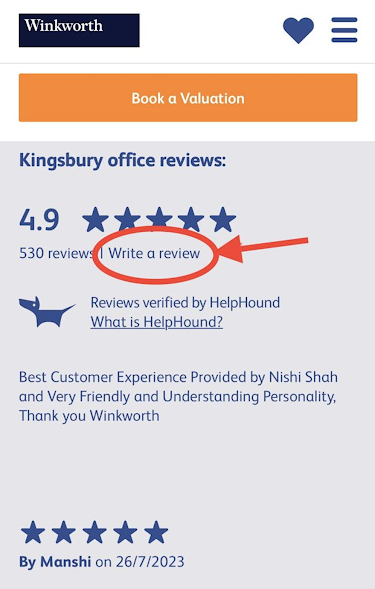
The red arrow is pointing at the key to all of our clients' compliance with the CMA regulations, as well as the route to moderation. By clicking on 'Write a review' anyone can write a review whenever they wish, and that review will be moderated to ensure, as far as is compliantly possible, that it contains no errors of fact or statements likely to mislead a reader


This also, by coincidence, provided proof of another kind. When faced with a business that is concerned with allowing all of its stakeholders to post a review whenever they choose - in other words: in compliance with UK law - we don't hesitate to point out that estate agency is hardly the least criticised business sector of all time, so, if we can show it working, for the professional agencies at least, how great a risk would a medical practice or a firm of financial advisers be taking?


So - after all of the above - are there any other benefits for your agency?

There are two answers to this - both of which provide tangible benefits for your business:
  1. Your clients will be grateful that you introduced them to HelpHound. There is no downside for them. They will be compliant with the CMA regulations from the day they join and just one look at our 'Results' will show them the potential uplift in enquiries through both Google and their own websites. HelpHound membership will earn them extra revenue over and above our fees, from the outset*. It also has the potential to make them significant savings on the likes of Google Ads, as well as the boost to their SEO.
  2. By becoming a HelpHound introducer you will be adding a growing quarterly income stream for your own business
*If you have a client that already has a score of 4.9 and 200+ Google reviews they will be just as glad they joined: aside from a continued compliant flow of reviews to Google, they will be hosting their own reviews - valuable data - on their own website and benefitting from our moderation going forwards. No more cherry-picking or gating and a great SEO kicker too.


Friday, 18 August 2023

Outbound marketing support - we'll help you get your ducks in a row

We are all familiar with canvassing emails - here is a pretty standard one...


Best practice after sending one? The follow-up call. And when this kind of email is followed up the salesperson knows exactly what to expect...
  • Not interested
  • Not interested unless you can - quickly - give me a reason to be interested
  • Interested
And in the case of the latter - those that are interested - we know what a significant proportion of them will already have done: conducted a web search. So what do we see when we search?


Google immediately offered, as its second most valuable search after the business's own website, a search for reviews. That means that, according to Google's algorithm, the second most relevant search after the business's own website is reviews of the business.

And right next to that search? The Google knowledge panel, which is expressly designed by Google to contain all the key information that both Google and any prospective customers of the business will need to know...


No reviews. Not a single one. How much easier do you think it would be to convert prospects if the business's knowledge panel looked like this:


It's easy to lose count of the number of times reviews appear in this business's Google knowledge panel - either their own, from their website, or from Google itself: their headline score - 4.9 - and the number of reviews - 311, 'Reviews from the web' - their own (HelpHound moderated) reviews - 4.9 again and 532 (also showing in organic search, along with a star rating - see the screenshot below - or conduct your own live search). And then the three rich snippets that Google has taken directly from their Google reviews - all rating the business 5*. What a profound - and powerful - difference when compared with the previous knowledge panel


Those 5 gold stars - and the rating and number of 'votes' are - surprisingly for some - not taken from the business's Google reviews, but from their own (HelpHound moderated) reviews hosted on their own website...


See them live here


The key...

When this business became a HelpHound client they had two Google reviews. They understood the power of reviews to drive business (in the form of clicks and enquiries) through search - and through their own website, and to power SEO, as well as minimising their outlay on expensive marketing such as Google ads, but they had, quite rightly, hesitated. Why? Because, like so many businesses, they were concerned that they had no legally compliant* mechanism with which to ensure that the absolute minimum of inaccurate, misleading or just plain unfair reviews they would get.

That was until we introduced them to HelpHound's moderation process, where every single review is read to ensure that reviews containing errors of fact or statements liable to mislead can be corrected prior to publication. And the rest - as they say - is history.


*Selecting customers to write reviews and/or using a mechanism such as a questionnaire to identify those most likely to write a 5* review are both illegal in the UK and the EU. We know you know competitors that do just that, but you also know that saying to a potential customer 'Yes, they have great reviews, but that's not hard if a business hand picks customers to write them; we, on the other hand, allow all ours to do so' wins business. You will find a short analysis of the law here.


Further reading
  • Results - every business that joins HelpHound is able to monitor the resultant increases in calls and clicks by referring to its Google Business Profile (previously its Google My Business report), which looks like this...


If for some reason you cannot find yours, either follow Google's instructions here or call us and we'll talk you through it.

Saturday, 12 August 2023

Using AI/Chat GPT to respond to reviews

So many businesses neglect to respond to reviews - their own or those on Google. We nag away - as regular readers of this blog will know - but often we are faced with 'too busy' or 'other priorities get in the way', so we thought we would see whether AI could possibly help.

So let's take some real-life examples and see what Chat GPT comes up with (and add a few pointers of our own). 

Here's what we asked Chat GPT:


And here is Chat GPT's suggested response:


Note:

  1. We gave Chat GPT no other instruction(s)
  2. Chat GPT's response took just over 1 second
  3. The business can edit Chat GPT's suggested response before posting it to Google
  4. There is currently no 'English English' version of Chat GPT, so you will need to correct American English - apologize etc. - aside from that Chat GPT's vocabulary and grammar is often better than some of the responses we see currently!

Here's another, this time for a firm of solicitors:


And for a 5* review (of a medical practice)?


Our conclusion

Of course, in an ideal world, we would have 100% of our clients responding to every review within 24 hours of it being posted, even if only to thank the reviewer for taking the trouble, but in cases where there would otherwise be no response at all, we think that AI may well have a role to play.


Monday, 7 August 2023

'Allowing' and 'Inviting' reviews - the crucial difference

As regular readers will know, moderation - the act of reading a review before publication to ensure, as far as is legally allowed, that it is not factually inaccurate or potentially misleading for future customers of the business under review - is a cornerstone of our service here at HelpHound. It has been described as the BUPA, or the AA, of reviews; something you hope your business will never need but is absolutely essential insurance against the time when such a case arises.

But how is moderation squared with the CMA core regulations? These state that...

  • a business must not prevent a customer from posting their opinion, whatever that may be
  • a business must not filter negative reviews in any way
  • a business must not control the timing of a customer's review
  • any business that invites any of its customers to post reviews, anywhere (on Google or a review site or, in the case of HelpHound members, on their own website) must allow all of its customers to post a review

It's those words in italics above that go to the core of moderation. If you look at any HelpHound member's website (all illustrations here are on mobile - the most used platform these days) you will see the following...


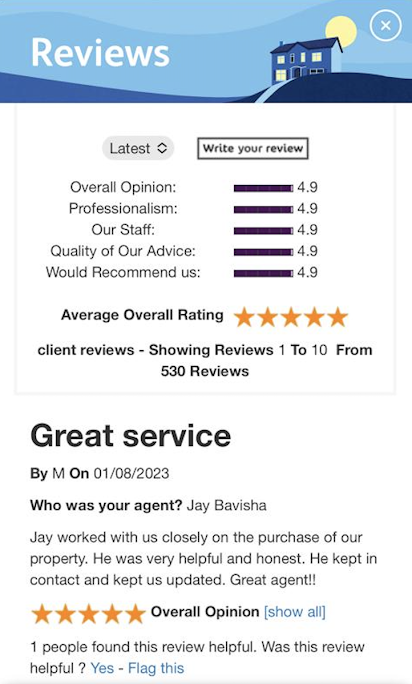
The reviews themselves (the most recent ones or all of them - that's up to the business) alongside a button that leads straight to all their reviews...


A 'Write a review' button that enables anyone to write a review to the business at any time of their choosing...


And finally - we incorporate a seemingly innocuous question: 'Was this review helpful?'. We estimate only about one in twenty readers bother to click this, so three 'Yes's' in less than four weeks is pretty impressive evidence that the review is being read...


What does this mean in practical terms?

By 'allowing' anyone who visits your website to write a review - that will subsequently be moderated by us - your business is fully compliant with the CMA regulations. You don't have to actively 'invite' all of your customers to post a review (although, of course, most of our clients do, and many go a step further and include a link to writing a review to their website in the signature block of their emails, for instance - because far better to have an inaccurate review written to your website where it can be moderated - and a customer possibly saved at the same time - than find its way direct to Google).

What follows from this?

Credibility. All of our most successful client businesses employ their reviews as a cornerstone of their sales and promotion practices - in window displays, on Twitter, Facebook, Instagram, and now even TikTok - as well as showing them to potential customers in face-to-face situations. And they are able to do this because they have a ready answer to potential customers who are, quite understandably, cynical about online reviews in general. They are able to both say and demonstrate...

  1. That anyone can write a review
  2. At any time of their own choosing
  3. That the review - every review - will appear on the business's website 
  4. And the reviewer will be automatically invited to copy their review to Google

Does this mean HelpHound can guarantee that a business will not receive any 'inaccurate, potentially misleading, or just plain unfair' reviews?

Bear with us! When we introduced moderation to reviews - the first, and to date the only, review management system to do so - we wondered just how much value such moderation would add for all parties concerned: the reviewer, the business under review, the regulators and Google. Well, ten years on we need wonder no more.

Let's first look at the moderation process in detail: 

Stage 1: the review is written and posted through the business's website - but not yet published; this flags up a notification to our moderator who reads the review.

Stage 2: The review falls into one of three categories;
  • it is 'clean'; it contains no spelling mistakes or grammatical errors - and is therefore posted to the business's website to be read by anyone visiting that site. An automated email is immediately sent to the reviewer inviting them to copy their review to Google. That email contains the text of their review and a direct link that opens the business's Google review box, so there's no chance of the reviewer saying 'I didn't know how to post a Google review' or 'I couldn't find where to copy my review'.
  • it contains spelling and/or grammatical errors that would render the review next to valueless for anyone attempting to rely on it. In most such cases our moderator will simply correct the errors without recourse to the reviewer. If it is impossible to discern the meaning of the review (bear in mind that nearly 10% of the UK population speak English as their second language) the moderator will email the reviewer asking for clarification.
  • it contains obvious errors of fact or potentially misleading statements (or comments that would render the reviewer liable for actionable libel - for an example see this case history). In this case the moderator will contact the reviewer and the business - separately - in an attempt to correct those elements of the review.
Stage 3: At the close of all three of these processes the review is published in its finished form, whether or not the reviewer and HelpHound (and the business) have agreed to modifications.

This latter point - 'whether or not...' is fundamental. Any attempt to prevent the reviewer having their say, however inaccurate or misleading that may be, will go against the CMA's core regulations. Before you say 'Well, here we are back at square one again' let's look at some real-life numbers. In a sample of 1000 reviews, we mined down to see which fell into each category: 871 fell into the 'Clean' category. That doesn't mean they contained perfect Byronic prose (or that they all rated the business 5*), just that they would make sense to the average consumer who might rely on them to point the way to a decent business (or not). 93 fell into the 'Spelling and or grammatical error' category, meaning our moderator corrected the errors and they were published. 36 fell into the 'errors of fact or potentially misleading statements' category and required dialogue between the parties in an attempt to iron out those contentious issues. In the end in only 4 cases did the reviewer insist - as is their right under the law - to have their original review published (at this point it is best that we remind you that the business has a right to respond under any review, be it HelpHound or Google). 


So: HelpHound's moderation has the following effects - definite benefits for all concerned...

1.  All the reviews posted to HelpHound and copied onto Google will make sense to a reader

2.  The overwhelming majority of reviewers that have their reviews corrected - be it for spelling/grammar, errors of fact, or potentially misleading statements - nearly 10 percent overall, are pleased that HelpHound intervened. It turns out that few people - fewer than perhaps we expected when we first introduced moderation - actively want their names (or even pseudonyms) attached to erroneous reviews, on the business's site or on Google

3.  A tiny minority go against the grain - down from four percent before moderation to a fraction under half a percent afterwards. This saves businesses from untold pain of the kind that can be experienced when on the receiving end of an unfair, inaccurate or plain misleading review - here's an example that we managed to have Google take down after it had made the national press. N.B., In this case, we had the expertise to a) follow Google's appeals procedure to the letter and b) establish as a matter of fact that the reviewer had no personal knowledge of the business under review - a contravention of Google's Terms of Service. Google will not, for instance, allow an appeal against a review simply because the business has no knowledge of the reviewer


How does all of the above benefit businesses?


How to stand out from the crowd - safely and credibly? And yes, those stars next to the business's listing (first in organic search, as well as leading the Google 3-pack) are derived from the business's own reviews.


It's simple: it gives businesses the confidence to 'invite' and 'allow' reviews - to their websites (where they own the reviews - an increasingly valuable business asset: data). It also contributes to the business's SEO in search (up to 15% of Google's total score according to sources - just check any HelpHound member's position in local search). And it means that the business is always in compliance with the CMA regulations (they won't be cherry-picking or gating) and, most important of all, it drives new business (see these case histories).

In summary

  • 'Allowing' reviews to be written about your business ensures compliance with the CMA regulations
  • 'Inviting' reviews does not mean you have to actively chase every single customer for a review - put candidly: you can leave 'Mr. Angry' off the list without any compliance issues, but bear in mind they can always click on the 'Write a review' button or post a review direct to Google. What do our clients tell us they do? Most would rather deal with such a customer offline and through our moderation process and then explain to readers that they have 'done their very best' if they ultimately choose to write a review to Google.

One thing is for sure: they feel that the advantages of HelpHound's moderation are more than justified given the other positive advantages of membership, far outstripping any comparable solution. We are, we believe, justifiably proud of the way that we enable our members to confidently put their best foot forward - if you are new to HelpHound please read this article about how those benefits can be quantified.


Monday, 31 July 2023

An interview with the joint CEOs of HelpHound

Robin Bruce and John Williams have been joint CEOs of HelpHound for over ten years. In this interview, we ask them the questions most asked by prospective HelpHound members.

Q1.  Online reviews have been around for the best part of twenty years now, what are the most important takeaways from your first-hand experience?


Robin: Linkedin

Robin: 'Three main things: first, businesses that commit to a proper reviews strategy unarguably win more business than those that don't. A great Google score and many Google reviews drive enquiries and clicks through search like nothing else. 

Next: product reviews are not nearly as valuable - or as influential - as service reviews. Consumers actively seek out and read reviews of medical, financial and legal services (as well as other high-value services such as estate agency) whereas they just go by headline scores for a new TV or a pair of shoes. Interestingly, consumers will buy a product that scores 4 out of 5 on any platform but when it comes to essential services they will apply a far higher benchmark and actively seek out Google reviews. A minimum of 4.8 from at least 100 reviews has to be the first aim for every business in those sectors.'


John: Linkedin

John:  'I'm in charge of moderation [all HelpHound reviews are moderated pre-publication on the business's own site and before the reviewer is asked to copy their review to Google]. In the beginning, we thought businesses would appreciate moderation as a 'nice to have' add-on to our main service: allowing businesses to own and display their own reviews; as time went by we - and our clients - learned that moderation is a life-saver for businesses. One well-written negative review can stop the phones ringing. We have a file of case-histories where businesses have approached us after such a review has been written on a public platform, and how they wished they had been members before. We can 'rescue' a business from such a position, but far better for it not to occur in the first place. Our statistics show that giving customers - clients or patients -  the ability to write a review to the business at a time of their own choosing results in far fewer inaccurate or misleading reviews being published on the business's own site or on Google.

Q2. How about review sites? 

Robin: 'They're great for reinforcing sales of products. Consumers do respond to star ratings when making product purchases. The question I would pose to any business where service is key (as opposed to products they might sell) is 'Would you rather have a score of 4.8 on Google or on XYZ review site?' Experience has taught us that the answer - for an absolute fact - is Google. The only reason most service-oriented businesses have opted for a review site, as opposed to Google reviews, is that review sites have salesforces and Google - in terms of reviews - don't.'

John: 'Many review sites continue to over-promise on many levels. In a way they have been forced to since Google - with their unrivalled visbility - came to online reviews after the review sites did. They are fully aware that Google reviews show first in every search so they have to add value in other areas; the problem is that they seldom do. It is illegal to use a review site to filter out negative reviews before asking customers to post a review to Google but it is so common that the regulators have given it a name [Gating]. Some review sites insist that the reviewer support their review with documentary proof of purchase if challenged by the business or they allow the business to control the timing of the invitation to write the review [there's nothing wrong with the latter as long as the reviewer can also write a review when they wish]; both practices are illegal in the `UK and EU'. Some review sites even offer to promote paying members over other businesses, a practice that is legal in the USA but also illegal in the UK and EU.'

Q3.  An outsider might have the impression that reviews are totally unregulated, is that not so?

John: the legal side is one of my main remits at HelpHound. Since the CMA [the UK regulator] wrote to businesses back in 2016 there have been very few cases of direct action against businesses flouting their regulations (which do have the full force of UK law). We have consistently advised non-compliant businesses that the main threat comes from competitors or ex-staff with an axe to grind who see (or know) that they are in breach. Competitors that see businesses in breach - and it is very easy to recognise those that are because, by definition, reviews leave a vivid paper trail - will simply use that fact against the business in question: 'Yes, XYZ do look very good, but then they would because [they cherry-pick/gate'].'


Step one: from here all good things review-related flow - moderated reviews shown on the business's own website; owned by the business, not by Google or a review site. Plus the overall score awarded by the business's customers and a click-through ('Write a review', top left next to the score and number of reviews) that allows anyone to write a review - ensuring full compliance with the CMA regulations.


Robin: 'We completely understand the temptation to flout the CMA regulations, given the power of positive reviews to drive business and the harm unfair negative reviews - even one - can do to a business. It's the main reason so many businesses either attempt to avoid engaging with reviews altogether or find themselves in breach. When we first speak or meet we are often told 'We had no option, we run a complex business in the [medical, legal, financial] field and if we obeyed the CMA's core rules - no cherry-picking and no gating - and allowed all of our [patients, clients] to post reviews our business would be put at severe risk'. It's why we introduced moderation and why moderation is so key to HelpHound adding value over and above simply inviting reviews direct to Google. Moderation is the AA of reviews - in the same way as no-one expects their car to break down but we all have motoring cover, when moderation does kick in it can be - often is - a lifesaver for the business.'

Q4.  Can you put some numbers to moderation? What proportion of reviews need moderating?

John: First: we moderate every single review. They are read by a human being, not an algorithm (does 'hot' mean good or bad?). It's not the volume, it's the individual review itself. A business can have half a dozen or more 1* reviews that complain about 'the attitude of the receptionist' or 'the business's inability to answer the phone within X rings' and, although such reviews will impact the business's overall score, they won't, of themselves, deter a reasonable person from contacting that business. 

But a single well-crafted but inaccurate or plain mistaken review that reads with credibility can - and will - do untold harm [here's just one example, where the judge awarded significant damages to the business for loss of earnings that the court had accepted were proven as a result of just one such review]. The interesting thing, in this context, is that very few authors of such reviews - containing factual inaccuracies or potentially misleading statements - respond negatively when contacted by one of our moderators. 

If I had to give a short statistical answer to the question posed I would say that we see between one and three such reviews in every hundred; of those less than three percent choose - as is their right in law - to have their original review published after moderation (and always bear in mind: the business has a right to respond to such reviews, both on their own website and on Google).'

Q5. What are the biggest mistakes made by businesses regarding reviews?

Robin: There's quite a list...

    • They use a review site when they would be far better served by using a moderated system such as HelpHound feeding through to Google reviews
    • They break the law - often unintentionally ('ignorance is no defence' etc,)
    • They don't fully integrate reviews throughout the business - and into their core CRM. You see this often - a flurry of reviews and then months when none are written
    • They are sceptical that review management will add value in terms of their bottom line; it will - definitely!
    • They copy what their competitors are doing when they could be trouncing them
    • They don't understand the SEO impact of hosting reviews on their own site (it contributes roughly 15% of the total - just check any HelpHound client's position in local search)

John: I would simplify what Robin has just said: HelpHound, in terms of cost and disruption, is so negligible by comparison with its benefits for any business, especially those in the professions and services, that the Number 1 mistake has got to be 'Not trying/testing HelpHound.' 
 
There's also the case of the client who thought that they would be just as well off inviting reviews direct to Google - until they fell victim to a such a damaging - and unfair - review that they dropped the Google review feed from their website altogether, thus going from HelpHound to Google to no reviews at all in a matter of months. When they came back to us we had to point out that changing their review mechanism as and when was a) probably placing them in breach of the CMA regulations and b) would be bound to be noticed by their competitors and used against them. Find a moderated system and stick with it. 


Q6. Can you quantify the results you produce for HelpHound clients?


Step 2: the business's image in search: Google includes so much review-related information - the business's rating from its own reviews (the star rating and number under the business's listing top left); its Google score and reviews, in the Google knowledge panel (on the right), with the reviews themselves just a click away.

Robin: In the early days, we marketed HelpHound as 'nice to have'. Because we had no hard numbers to back up our logic. That logic told us that a business with a great review score on its website and on Google would attract more customers than one that did not. 
 
For some years now we have had the numbers - thanks, in part, to Google - Google reports increases/decreases in enquiry flows every month, direct to the business, so any uplift becomes rapidly apparent, and in part by some detailed competitive analysis done in an article on an estate agency industry forum that compared the results for two clients of ours against their main competitors.  


A screengrab of a typical client's Google report, just one full month after implementing HelpHound. Does professional review management pay for itself? You bet it does.


From an outsider's perspective, it would, I'm sure you would agree, be hard to differentiate between London's two dominant agents - Winkworth has over 60 branches in London and Foxtons is not far off that number. Both invest heavily in presentation and marketing. Both have strong sales and lettings operations. But just pause a second and read the numbers here, put together by another agent. Without knowing, as we do, that Russell White, head of Winkworth's Putney office, majored in testimonial-driven sales before his branch became a client over five years ago, wouldn't you still be tempted to trial the only obvious differentiator: HelpHound membership?


John: As the person responsible for statistics within HelpHound I will put some numbers to Robin's comments:  HelpHound clients report average uplifts in calls and clicks through Google between 15 and 25 percent. We have outlier clients that have reported in excess of 100% uplifts in the first 12 months of membership. And we obviously have clients who score near 5.0 with lots of Google reviews when they join that won't see such dramatic uplifts but value CMA compliance, the SEO kicker and moderation going forwards, as well as the facility to host their own reviews on their website and the maintenance of their competitive position. We have never had a client report a fall in such numbers. 

There is more to effective review management than simple lead generation; quality of business is important as well, and the independent numbers support an uplift in that too. In this context the report that Robin is referring to above compared two very similar businesses - in estate agency - where our member had a sales inventory nearly twice as large as its competitor and a monetary value per transaction over 72 percent greater. Not only are they attracting more clients, each client is earning them significantly greater fee income.'


Q7. And finally, what would your advice to any business reading this article be?


In many areas of business there are, as is illustrated here, so many more businesses competing for visibility in a Google search than Google can possibly cram into any kind of screen, be it desktop, laptop, tablet, or phone, and we all know that consumers will, all other factors - high score, many reviews - being equal, be drawn to those that dominate in search. There are upwards of twenty pins in this map, but just how many potential fee-payers will click through to one of the top three (by the way, that rich snippet 'Good service...' is drawn, by Google. straight from one of their reviews)? 


John: The potential rewards a service business will derive from HelpHound membership so far outweigh the cost that a trial membership is a no-brainer. 

Robin: Surprise: I agree with John 100 percent. Come on in! I'd just like to add that, unlike many things one does in business, there's absolutely no downside risk whatsoever. The very worst that can happen is that you'll have a fully-CMA complaint review management system and a great extra CRM channel, plus an SEO boost. But if you see no uplift in enquiries or the quality of the business you attract just speak to one of us and I will bet my bottom dollar we can put that right for you (if you interrogate this blog - box top right -  you'll see just how much more we do for our clients here at Helphound - we provide a Service with a capital 'S', not just software).


And finally: a note to our readers...

If there is a question that you feel we haven't answered or should include here, please email either Robin - robin.bruce@helphound.com or John - john.williams@helphound.com and we'll answer you direct. We may even include it - and our answers - here.