Wednesday, 17 May 2023

Deflection - it's hurting so many businesses

We first coined the term 'Deflection' back in 2017 to describe what happens when a business actively invites its customers to write reviews to a review site, as opposed to (or even as well as) Google. So often the business's happy customers will do just what they are asked to do, whether face-to-face or by email: write a review to that review site. So far so good? Well, no actually.

Let's take an example: ScS Sofas. We've all seen their advertising and there's a fairly good chance that you're reading this article sitting on one of their products! Why have we chosen ScS? Because the proof that deflection is hurting their brand very badly in local search - and who searches for a sofa supplier outside their locality? -  is so concrete that it's as near to irrefutable as it could be.

First: look at their chosen review site - Trustpilot...


...how much better could you possibly want your business to look? A score of 4.8 out of 5 from nearly half a million reviews.

So what is the problem? You guessed it: deflection. By inviting happy customers to write reviews to Trustpilot - in-store mainly, immediately post-purchase - they are getting almost all of their positive reviews posted to Trustpilot. So what's wrong with that? 


The purpose of reviews, as far as the business is concerned - is to do two things...

  1. Bring customers conducting an initial web search to the business's website and to their physical stores
  2. Reinforce the sale - 'Half a million customers can't be wrong'
But what actually happens when a consumer performs the two most overwhelmingly common searches? This...

For 'Sofa'...


For 'ScS'...


But surely the Trustpilot reviews show up in searches? Well, no, not really (actually they do, but halfway down page 3 of a Google search - which is akin to not showing in search at all).

But back to deflection. Why the disjoint between Trustpilot and Google scores. The answer is simple: unhappy customers are posting their reviews to Google. We have just shown one location, but we can assure you that the experience is replicated across just about every one of ScS's 97 other locations.

And the answer? Focus on Google. Apart from anything else the business's score on Trustpilot is just about bulletproof with that many reviews, and there's no reason why it shouldn't be on Google too. Add moderation from an independent review manager such as HelpHound and the business will benefit from this positive triple-whammy...

  1. HelpHound moderation will reduce to a bare minimum the number of factually inaccurate or potentially misleading reviews that are posted to Google or anywhere else
  2. The business will own its own reviews - they contain extremely valuable data
  3. The business will benefit from the SEO kicker that comes from hosting its own reviews - as well as the stars in search you see below...


Those 501 reviews are the business's own, every one moderated by HelpHound and hosted on the business's website, and it is they, not the business's Google reviews, that generate those stars in local search


In summary

HelpHound's moderation gives business's the confidence to invite reviews direct to their own website and then straight on to Google. If your business is looking for a safe and secure solution to reviews, with immediate and measurable short-term benefits (more calls, clicks and visits) and long-term positive results then look no further.


Further reading

No matter what your line of business, if there is an element of customer service involved, HelpHound is the proven review management service you need. Here is an article that goes into depth about the kind of results that we will - notice we say 'will', not 'can' - produce for your business.


Thursday, 11 May 2023

Purplebricks - and what its experience with reviews can teach us

If 

If ever there was any doubt as to the credibility of review sites, especially when compared with Google reviews, the sorry Purplebricks saga has put an end to it. Here is a link to this article.


From their inception, review sites have been a major plank of Purplebricks' marketing, as they are for many businesses. The crucial question is 'Should they - review sites, as opposed to Google - be?' or is there a better alternative? Let's see...

Here they are, today, on their own website...


Here on Feefo...


And on Trustpilot...


Why would Purplebricks - or any other business - use a review site?

The answer, we are afraid, is simple: it allows the business a degree of control over the following...

  • who is allowed to/invited to write a review: in order to write a review on Feefo you must receive a unique invitation from the business to be reviewed with an embedded link, for Trustpilot just the invitation (it is possible to visit Trustpilot to leave a review, and some people do, but most that don't receive that invitation and want their voices heard head straight to Google)
  • the date of that invitation
So: your business cares - quite rightly - about its online reputation. You look at the 'advantages' listed above and your first reaction? 'Great, we can control who writes reviews.' Unfortunately, that has two far-reaching consequences...

  1. It is illegal - it is in direct contravention of the UK's CMA's regulations which specifically state that 'a business that actively invites reviews must allow all of its customers to write a review' and that 'the business must not control the timing of the writing of that review.'
  2. It results in what - back in 2018 - we christened 'deflection'. It drives uninvited dissatisfied customers to write their reviews direct to Google.


So what does Purplebricks look like on Google?


It is also an unfortunate truth for businesses that employ review sites that Google reviews, in over 98 percent of cases, feature far more prominently in searches. They are shown front and centre for just about every business search.

Just look at this - or search for your own business...


What does the searcher see? Trustpilot reviews? No. Feefo reviews? No. Google reviews? You bet!

'But...' - we hear you say (and it is a big 'But') 'We have no control over who writes a Google review, and no recourse once a Google review, however unfair it may be, is written.' 

Funnily enough, this is where HelpHound comes in. Our core offering is moderation. 

What, exactly is moderation? It means first inviting the review to the business - via its website; this enables the independent moderator - Helphound, in this instance, - to check the review for factual errors or statements likely to mislead future readers. Far less than five percent of the reviews we see require moderation, but when they do it is often crucial: misunderstandings over billing, blaming the business when a third party was actually at fault, and so on. Reviews that, if published - either on the business's website or on Google (and we ask reviewers to do both - and about 50% do) can do untold harm, both to the business and to the consumer that may be put off using a business that is ideally suited to their needs.        

How do we enable businesses to comply with the CMA regulations and look good at the same time? The simplest answer is that we only work for great businesses, but even great businesses need moderation - because customer/client/patient misunderstandings will always arise. If you look at this example you will see what we mean: here's the business - a client of ours...


...and we know them well. They are a very experienced and dedicated team. But just once in a while, even they get a review that our moderators have cause to query - and in every case since they joined five years ago the review has either been re-written by the client before it was published or withdrawn. 

Once reviews are published on their website (498 there to date) the reviewer is automatically asked - by HelpHound - to copy their review to Google. As you can see 284 have done so. The combination of the business's professionalism and our moderation has them listed as the top business in their sector in local search (also helped, no doubt, by the SEO kicker provided by hosting their own reviews on their website). 

Most important of all, our moderation gives them the added confidence to invite reviews in the first place, in the certain knowledge that factually incorrect or potentially misleading (and, ultimately, potentially damaging) reviews will be challenged and - for the most part - corrected. 


And, by having the standing invitation on their website - see above - they comply with the law. They don't have to proactively ask 'Mr Angry' to write a review, but he can click and post one if he wants. That way at least they - and he - will benefit from moderation (you might be surprised to see just how many messages we see coming back from the reviewer - in private - saying things like 'Thanks for putting me straight' and 'I'm glad I had the opportunity to understand [X] before my review was published').


Conclusion

We are not suggesting that Purplebricks would have thrived as a business if it had focussed on Google reviews, just that it would at least have had reviews from those with a positive experience there for consumers to see. Moderation cannot magically make reviews from consumers who have had a negative experience go away, and nor should it, but, as we have said above, it does give the business the confidence to invite its customers to post reviews to Google.

The core message is that if reviews are important to your business, and if you are in the service sector: financial, legal, medical, marketing, recruitment and so on, they will be, we provide the most up-to-date, proven (see 'Results' below) and effective review management platform available today. And it won't cost your business the earth - almost certainly less than an equivalent business would be paying Feefo or Trustpilot.


Further reading...


Friday, 21 April 2023

Google reviews - back to basics

We have not published a 'back to basics' article for quite a while, but judging by our day-to-day experience, plenty of businesses will still welcome it. Please persevere, even if you think the first one or two topics are pretty basic - getting the basics right, as we all know, is just as important as understanding the finer points. So here goes.

What are Google reviews - and why are they so important?


At a glance - a great score from a credible number of reviews and excellent Google rich snippets

1.  Google reviews are the first opinions a potential customer will see of your business. Always. They will appear in every single web search on your business name - even if the customer is simply looking for your telephone number or address. It is a mistake to think that reviews are only read by those actively looking for them. 

2.  Like it or not, they are read by anyone and everyone who interacts with your business. Ask any customer/patient/client (we'll simply call them 'customers' from here on in) and they will confirm this, from the patient in the dentist's chair to the divorcee in the lawyer's office. And they are read more the more high-value the service you provide. Selling toasters? A high review score will shift products but the individual reviews themselves will convince someone to at least make first contact with a doctor, financial adviser, solicitor or estate agency.

3.  They are believed. Not all of them, but consumers nowadays have learned to take a business's headline score as a shorthand way of whittling down their options. Your competitors score 4.8 and your business scores 4.6? Your competitor will get more enquiries than you do. Verifiable fact (verifiable by reference to your monthly Google My Business statistics).  The difference between having a great Google score with great reviews - not always one and the same thing - will make the difference in getting serious volumes of customer enquiries through Google to very few, or even none at all.


What are the most common mistakes that businesses make with Google reviews?

1.  They don't take them seriously. We call this 'review denial'. Expressions such as 'What kind of [blank] writes a Google review?' or 'Who would believe a Google review?' and 'Who chooses a business on the basis of their reviews?' are still heard around boardroom tables in 2023.

2.  They don't take the quality of their reviews seriously. They are happy with one-liners or simple ratings (reviews with scores but no content). Consumers search out and value detailed well-written reviews. 

3.  Businesses don't respond to their Google reviews and if they do they often only respond to critical reviews. Besides being plain good manners, responding to every one of a business's reviews is proven to reduce the incidence of negative reviews.


What alarms businesses about engaging with Google reviews?

1.  The very points made above: that Google reviews are highly visible and credible and, as a result, they can dramatically impact lead flow through search - add to this the fact that it is extremely difficult to get a Google review removed (unless it is demonstrably and provably factually incorrect - and even then it's a struggle) then we begin to understand why some businesses will either game the system - often going so far as to break the law - or retreat into the above mentioned denial and not engage with Google reviews at all.

2.  Conforming with the law. In the UK the law states that a business that invites any customers at all to write a review must allow all of its customers to do so. It also states that the business cannot control the timing of the review. It takes a brave business to allow all of its customers to write a review.


How does HelpHound enable businesses to reconcile all of these factors - both positive and negative?

In a word? Moderation. Given that a business cannot opt out of Google reviews it has to find the best practicable solution that takes all of the above into account...

  • one that allows all of a business's customers to write a review
  • at a time of their own choosing
That's step one. After all, adopting a system outside the law...
  • by cherry-picking (selecting known happy customers to write a review)
  • and/or by gating (sending out a customer survey to establish which customers are happy before only inviting those to write a review)
...not only invites legal sanction by the CMA but plays right into the hands of competitors (after all, there's probably no more powerful disincentive to doing business than the knowledge that the business in question has illegally massaged its image).

So: back to moderation. What - exactly - is it? It is the act of reading a review pre-publication to ensure, as far as is legally possible, that the review contains no errors of fact or wording that may be likely to mislead a reader. Here's the process...


From the 'Write a review' button on the right all the benefits of professional - moderated - review management flow

1.  The business emails their customer inviting them to write a review to be published on their website - or the customer sees the invitation to write a review on the business's website (see example above - even look up Shepherds' website - and see what they look like in search).

2.  The customer writes their review and submits it.

3.  The review is read by a moderator. By definition that moderator must be independent of the business (yes, this is where HelpHound comes in).

4.  If the review contains no factual inaccuracies or misleading statements it is published to the business's own website and an automated email is sent to the reviewer inviting them to copy the review to Google. This applies to over 95% of all reviews.

5. If there are issues with the content of the review the moderator will inform the reviewer and the business, simultaneously. This happens in the case of less than 5% of all reviews and in 97% of those cases the review is either withdrawn by the reviewer or revised and then published. In less than 3% of cases is no resolution arrived at and in those cases the original review is published (with the business having a right-of-reply).


This is the aspect of our service that provides all the reassurance businesses need to fully engage with reviews. From the numbers above you can see that the chances of an 'unfair' review being published about a business are vanishingly small compared with inviting reviews in a legally compliant manner to Google direct - 3 percent of 5 percent: roughly 1.5 in a thousand.                                                                                                                                                                                                                                                  
For more about HelpHound and our services to professional high-value service businesses please don't hesitate to call us on 020 700 2233.


Further reading...

Monday, 27 March 2023

Trustpilot - what a waste of effort

Today we received a sales email from the UK Energy Bureau.  Their signature block included this...


Which is derived from this...


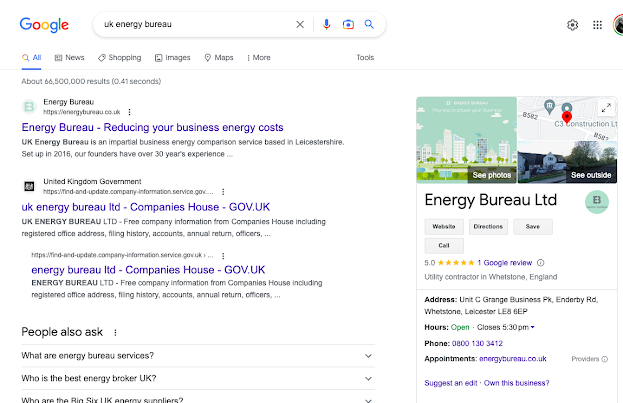
Over three hundred glowing reviews from customers. But wait! What would you see if you were to search for this business online? This...


What a shame. When so many of those customers - all of them, in fact - could have been asked to post their reviews to Google.  

Just in case anyone thinks we're picking on Trustpilot, a day later this email arrived...


With the business showing marginally better on Google...


but looking just awful on Trustpilot...


None of which would be keeping anyone awake at night if the business hadn't had all of its efforts diverted to a review site that's nigh on invisible in search, but had, instead, devoted those efforts to getting reviews to Google


The basic rules of effective review management   

  1. Own your own reviews - data is gold, and your customer opinions are platinum. Don't give them away to any other business
  2. Have them moderated
  3. Display those reviews on your own website
  4. Get as many as possible across to Google
Look like this...


And this...


And, perhaps, most important of all - in local search - like this (those gold stars and the rating are from the business's own reviews, they're not Google's - although many consumers assume they are )...


Getting to look like this requires commitment and hard work. Make it count.


And just before you dive in and post a Google review widget on your website

Let us remind you of the benefits - some of them absolutely vital for high-value service businesses - of employing a moderator such as HelpHound...

  1. We will correct faulty English (bad English devalues the power of even the most positive review in the mind of the reader)
  2. We will ensure, as far as possible, that the review contains no errors of fact (if they do, we will intervene and initiate a dialogue between the reviewer and the business to resolve those errors)
  3. We will weed out fake reviews*
  4. We will not post 'accidental' reviews**
  5. Moderation will give you the confidence to invite reviews through your website, especially misleading or inaccurate negatives that might otherwise be posted unchallenged to Google
  6. We will provide your business with an extremely effective defence against what we call 'killer reviews'. These are negative reviews that are so powerful that they have the potential to stop the clicks and calls coming through to your business (one may suffice: if you doubt this, please read the terrifying case history under item 2 in this article)

The result of all of this - collectively known as moderation - is...

  • Fewer inaccurate or misleading reviews (which ultimately means fewer unfair negative reviews, the 'killer' reviews especially)
  • More credible reviews - to both your website and Google
  • Full compliance with the CMA regulations

* Fake reviews: if w are in any doubt whatsoever as to the veracity of a review (or a reviewer) we will challenge the writer to substantiate their opinion. If they do not, the review will not stand.

**'Accidental' reviews: you might be surprised just how many happen over a given period. They might be unfinished reviews (where the reviewer has pressed submit before they've finished writing their review, or they might be reviews of the wrong business altogether (we reckon between one and two reviews in every hundred fall under this heading). 


Wednesday, 22 February 2023

Don't be held hostage by a threatened negative review

This article appeared in yesterday's press. It describes a couple who managed to stay in a pretty upmarket hotel for over two years, for free. Only with a change in management is the hotel attempting to recoup over 200,000 from them.


But why would a hotel - or any other business, for that matter - allow a customer so much leeway? One answer we hear of quite frequently is the threat, real or implied, that the customer may write a less than complimentary review of the business. In its most basic form this used to be really quite common when Yelp strode the streets in the UK; Yelpers - as they called their reviewers - would often suggest that a restaurant booking from them would 'help' the business climb the Yelp rankings. The implication went further still, as far as 'not presenting a bill for the meal' would further enhance the business's chances of achieving the holy grail of multiple five-star reviews.

Individuals very often use reviews as a back-end negotiating chip when presented with all kinds of invoices. We even had to draft a statement for one hospitality client that was placed at their reception which ran along the lines of 'Please be sure to raise any issues during the course of your stay as we are unable to retrospectively adjust your invoice upon departure.'

Our advice to businesses? Never, ever, give in to such blackmail. By all means discount or refund if and when a customer has a valid complaint, but don't respond to 'I may have to write a negative review unless...' with anything other than 'That is your right, but please be aware that we respond to all our reviews, both positive and negative.'


What to do if such a review is posted?

Every site that hosts reviews has a procedure; Google's own starts here. Every one is different and some require considerable hoops to be jumped through. So our advice is to contact someone like HelpHound that has years of experience in guiding businesses - here's a case history from back in 2016 where the business made the national newspapers before we helped them get the offending and very damaging review taken down - their reservations had fallen to zero as a direct result. 

In the case of Google there is a detailed appeals procedure: miss one step and your chances of having the review taken down reduce from small to vanishing. We conduct an average of one such appeal every month.


Respond

Respond, respond, respond. We cannot say it often enough. Respond to every review your business ever receives, positive or negative, short or long, well-written or not. Not just because it's good manners but because it sends a very strong message to anyone tempted to be even slightly loose with the truth. They will see that their review won't go unchallenged.

But don't take the reviewer on. Remember the audience for your response is not the reviewer (they will seldom retract or change their review) but your future potential customers. So don't write a response that will show you in anything but the most positive light. Be understanding and polite (even if you don't feel that way).


The importance of Moderation

As the case history referred to above shows, one well-crafted but inaccurate, potentially misleading or just plain unfair review can stop the clicks/calls/tills dead in their tracks, no matter how many positive reviews the business may have. 

But it only applies to service businesses. Retail doesn't need 5 stars all the way. Service and the professions do. Consumers will buy a toaster that scores 4.0 out of 5.


But a medical professional - or a lawyer - or a financial adviser - or an estate agent? No way. Or at least not nearly as many as would if the score was 4.8 or better.  Click-through rates and Google My Business reports have been confirming this for years. The higher the score the more clicks and calls. End of.

So what exactly does moderation achieve? It ensures that the reviews of the business in question provide maximum value for the consumer, by being as accurate and least likely to mislead as possible. 

Note we don't say 'as positive' - because moderation rarely turns a negative review positive, even if the reviewer ends the process understanding why exactly their review was factually incorrect or potentially misleading (or, again, just plain unfair on the business). The best outcome, realistically, is that the reviewer decides not to post their review (although they retain the right to do so at any stage in the moderation process, which is handled by a 'real-life' HelpHound moderator, not some algorithm).

It is, in effect, insurance - for both the reviewer and the business - against misleading reviews of all kinds.


Wednesday, 15 February 2023

HelpHound - the Bullets

There are way over a million words in this blog - and we don't regret publishing a single one of them; they're an outstanding record of some of our clients' most successful strategies and some of the older articles prove that we knew what we were talking about, even back in the day!

But we fully acknowledge that some people would rather have a simple list of the benefits of HelpHound membership, so here goes...

1.  Enquiries through the business's website up - evidence: anecdotal, from clients - ask any client whether or not they would lose business by taking their reviews off their website and the answer will be a universal cry of 'Dead right we would',  and evidenced by our extremely high client retention rate (currently virtually 100% for 2022/3).


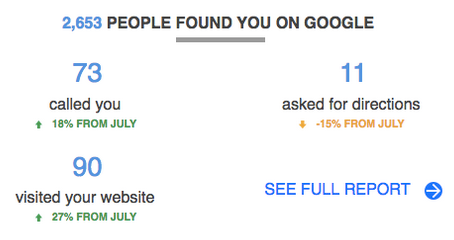
 A screengrab of a client's Google My Business report (these are automatically sent monthly to every business with a Google listing, if you haven't seen yours contact us).


2.  Enquiries through Google up  - evidence: clients' Google my business reports. These vary, but commonly report between 15 - 25 percent uplifts from scratch, but we have seen uplift numbers in the hundreds. What we do know, for certain, is that looking great on Google - stand-alone and against competitors in search - dramatically increases inquiries through Google.

Estate agency: a high-value low volume service business. Achieving at least a review a week (they had two Google reviews in the two years before they joined).


3.  More reviews: to your own website - you and your staff will be far more likely to invite your customers to write a review in the knowledge that inaccurate, misleading or plain unfair reviews will almost certainly not see the light of day (see point 5).


Reviews: current and convincing. over 450 of them. Front-and-centre of their website for good reason.


4.  More reviews: to Google - we target our clients to get half of the reviews that appear on their website copied to Google. Some achieve a higher percentage, but fifty is a good starting point, and will ensure there are always fresh reviews appearing on Google (consumers like to see recent reviews). See example above.

5.  Fewer inaccurate, potentially misleading or just plain unfair reviews: anywhere - if your business and, more importantly, your customers are perfect, move on to point 6, otherwise you will learn to value our moderation almost more than any other point: the amount of factually inaccurate, potentially misleading or 'unfair' reviews that we manage before publication is small - usually less that 3 in every 100 - but goodness, the potential damage such reviews can cause, if published, is immense.  

6.  Rank in local search: boosted - 'hosting your own reviews on your own website' gives your business credit from Google where local search is concerned. It is no accident that over ninety percent of our clients appear in the top three of any given local search.


Top of local search - consistently (we can't take all of the credit: their website is very well optimised) but the stars in search are drawn directly from the reviews they host on their own website - the only business in that location that has them, in a very crowded market. See below how that is saving them on Google Ads...


...with a great quote pulled from one of their reviews.


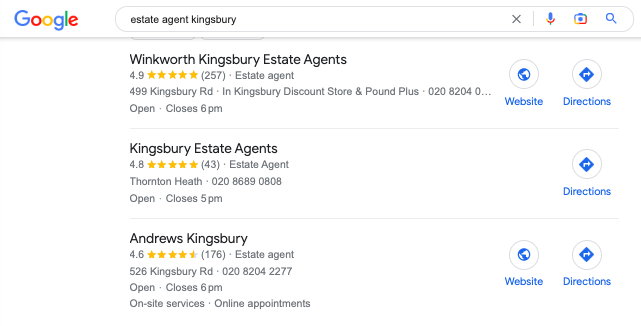
7. Appear in the Google 3-pack - many web users believe Google hand picks businesses that appear in the 3-pack. It doesn't. It's based purely on Google's algorithm, and that algorithm gives credit for businesses that host their own reviews - some industry experts estmate up to 15% of a business's score for that alone.


A great score supported by over 250 reviews. Driving clicks? You bet.


8. Stars: in local search Just like the Google 3-pack - and indeed all of search - where many consumers are influenced to click on a business based purely on how high up the rankings it appears (when did you last go to page 2 of any Google search?), many consumers assume these stars are somehow 'awarded' by Google. They're not (they are derived, by Google, from the business's own reviews on their own website, not their Google reviews), but they surely drive clicks and enquiries. See screenshot under 6. above.

9. Staff morale: boosted - clients consistently report the positive impact a great review has on staff - and management - morale. And, interestingly, that doesn't wear off with time. Why? because staff, even back office staff, like seeing their work appreciated, especially when they know that their reviews lead to increases in business.

10. Great marketing ammunition - our best clients don't just stop when they look great on their own websites and on Google. They mobilise their reviews in all of the marketing - customer opinions make for great advertising and PR as well as lending themselves really well to socal media.


Last but not least

As you can imagine, the Plc referred to in this article has been approached by many rival solutions over the years - in fact, just about all of them - but every time we have been able to demonstrate HelpHound's value for high-value service businesses. As a service-driven business ourselves we completely understand the difference between inviting a review of an item of clothing or a dishwasher and doing so for such a potentially complex transaction as house sale/purchase/letting or the equivalent in the financial, legal or medical sphere.

Conclusion

Sometimes clients pick out one of these points and attribute value to them way over and above all the others - usually 2, 5, 6 and/or 8 lead the way - but it's the whole package that adds value, just different aspects at different times. For more on any of the subjects listed above just interrogate this blog or speak to one of us. Welcome to HelpHound. 


Saturday, 11 February 2023

'Invitation only' review sites - seriously? still?

We first highlighted the fundamental flaws in this kind of site back in October of 2016 - nearly seven years ago. Flaws from the point of view of businesses and consumers. We also made the legal position clear.

With a heavy heart, we repeat - and update - those arguments again at the beginning of 2023.

First: what exactly is a closed review site? 

Closed, or 'invitation only' sites       

These sites only allow reviews to be written at the express invitation of the business that is under review.  At first sight this seems like a thorougly good idea - what's not to like about a site that only allows reviews to be written by customers that have been expressly invited to do so by the business?

Our regular readers will already have spotted the immediate advantage this gives the member businesses of these sites. But there are disadvantages too - and worse: regulatory issues. 

Now: what are these disadvantages and issues inherent in closed review sites? We'll deal with them one at a time.


Credibility

Just read this review of a 'closed' review site (on an 'open' site)...


We understand why a business may be attracted to a solution that allows it to select which customers to invite to write reviews of its service, but, once potential consumers understand that is how their chosen system operates, what credibity does it have? And what credibilty will the business have?


Reach

Another issue with review sites - as opposed to Google - is that their reach is so much less than Google. Every time anyone searches for a business they see that business's Google reviews - even if they are not looking for them.  Review sites simply don't feature in search by comparison. So that means paying for Google ads - and that means charging monthly fees to their business members. Monthly fees that would be far better spent on a Google focussd moderated system (see 'Solution' below).


Deflection

This time from 2018: 'What is deflection?' It is the unintended consequence of focussing a business's review efforts on a review site rather than Google. It results, almost universally, in the business looking good on their retained review site - which could be an open or a closed site - and less good, with considerably reduced numbers of reviews, on Google.

Why 'less good'? Because those not invited to write a review increasingly find their way to Google and will write a review there anyway, especially if they are motivated by dissatisfaction, percieved or otherwise. If your business offers an 'open' review system to customers - here's one:


...where anyone can click on 'Write a review' - then they will use it. Once the review is published on the business's own website every reviewer is then asked to copy their review to Google, where the business shown above looks like this:


 Legal and regulatory position

This is the clincher. We suppose we could/should have led with this paragraph, but we wanted you to understand the logic for not using a closed site before we slammed the door.

It is illegal - in the UK at least - to use a review mechanism that allows the business under review to select a) the customer who is to be invited to write the review - whilst denying such a right to another customer or stakeholder and b) the timing of that invitation. 

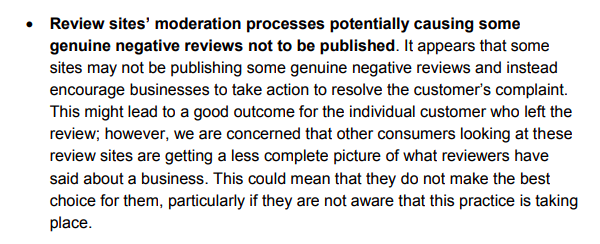
In plain English: your review system should allow anyone to write a review. There should be no barriers and no 'selection'. Please feel free to read the following extracts from the CMA's report on 'Online reviews and endorsements', but the conclusion remains the same: avoid using any closed review site.


The solution

There are two, practically speaking. The first is to simply invite your customers to write a Google review. This will be adequate for retailers and suchlike businesses that are straightforward and involve little or no complex service element. And, unlike the closed sites, it will be free. And as Google is 'open' for anyone to write a review you will be CMA compliant.

The second is to adopt a moderated review management system. What will this do? It will enable you to allow any customer or other stakeholder to post a review to your website at a time of their own choosing.   

How does moderation add value?

The first thing to say is that it won't prevent anyone from writing a negative review. But then neither will Google. What it will do is enable your reviewer to have a chance to correct their review - if it contains a factual inaccuracy or a statement likely to mislead a reader who may be likely to rely on that statement when making their choice of business based on the firm's reviews. 

Our moderation process makes clear to the reviewer that they have the right to post whatever final review they wish - that's what keeps it compliant. But long experince has taught us that in over 97 percent of cases over many years the original review is corrected pre-publication.

So, you only really have one question to answer: does your business provide a complex - legal, financial, medical, for example - service and therefore need a moderated review system? Or are people buying a simple - often visual - product from you, in which case inviting reviews direct to Google will suit you just fine.

Speak to us and we'll help you decide. And, hopefully, enable you to look like the business shown above.

Historical note

We are proud to say that we were the first to use the term 'moderation' as it is applied to reviews (it's an industry-wide standard now - even used by the CMA). It seemed logical at the time - moderators kept online forums free from spam, factual inaccuracies and abuse, so why wouldn't our moderators do the same for reviews?