Showing posts with label Review management. Show all posts

Thursday, 9 May 2024

Online Reviews - a Guide for the Consumer


Review Sites

What could concievably go wrong with a site that specialises in hosting consumer experiences of businesses? The answer, unfortunately, is 'quite a considerable amount'.

To understand this it is probably best to look at some recent history: until Google allowed its users to post reviews in 2007, the review sites - Judy's List, Yelp, Trustpilot, Feefo and so on - had a free run. Little competition when it came to hosting consumer views on the web. Consumers had to find the individual sites in search and then visit them to see reviews of businesses. So businesses had to engage with these sites to look attractive to consumers. So far so good.

Then along came Google and destroyed the review sites' attractiveness to businesses at a stroke, with...

  • Far greater visibility - think about it, you search for a business and what do you see, first and always? Yes, Google reviews
  • Far greater credibility - we all know Google, and we all know Google knows who we are, and every search we make 
and, most important of all...
  • For free - for the business and the consumer
This forced the review sites to search around for other USPs, and, in most cases, the only one they could find to justify continuing to charge businesses was to allow businesses some way of ensuring that they would be given every possible opportunity to look as impressive as possible.

This, in turn, led to some questionable practices such as allowing the business to challenge negative reviews (Trustpilot*), control access to the review site and the timing of the invitation to write the review (Feefo) and, in the case of the big daddy of them all: buy their way to the top of the list (Yelp). Yelp, the biggest quoted review site on the planet, was even forced to give up marketing in the UK and EU as a result.

*The site allows businesses to challenge any review and insist the reviewer provides proof of purchase. In theory: a good thing, in practice it tilts the scales heavily in favour of the business as few negative reviewers go to the trouble of finding an invoice from days/weeks ago.


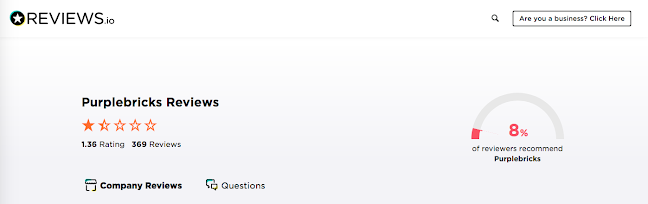
Reviews of review sites on competitor sites are instructive:


We make no comment on the individual reviews, but the overall impression created is one of hundreds of people trying to write critical reviews of businesses but in some way finding they cannot.

Our advice, to both consumers and to businesses, has been to avoid the review sites and focus on Google reviews to the exclusion of all others.

Google reviews

What do you see - every single time your search for a business? That's right - Google reviews. So it is vitally important that those reviews deliver on reliability and trustworthiness. And, by and large, they do...

  • Most are attached to a 'real' person - 'Jim Smith' rather than 'MickeyMouse123'
  • Google knows an awful lot about the reviewer - after all, it has their search history (and a great deal more besides)
  • The business can respond to each and every review without paying Google for the privilege, and this keeps most reviewers and their opinions honest
  • Businesses can appeal reviews (albeit under a pretty strict set of guidelines)
But there are drawbacks...
  • Fake reviews can be posted - they may be removed if challenged but many remain
  • Businesses can post reviews of competitors' businesses - it is endemic in some sectors (hospitality, for one)
  • Ratings are allowed - a simple 1* with no text, for instance - these, we submit, are helpful to no one


Sites that promote reviews (lead generation sites)

These include virtually any trade-specific site - from hairdressers to plumbers and dentists to gyms. They earn their living by effectively selling the potential customer to the business. Here's a review of one on Google...


This reviewer - on Google - has identified the fatal (and almost certainly illegal - in the UK, at least) flaw in this lead-generation site. Interestingly the site has the ability - as does every business on Google - to respond to this review, but has not done so.


If the website makes divulging their recommended businesses conditional on you giving your name and address, phone number (and email) it's a massive red flag. They are selling your details as a lead to one of their member businesses.

The rule of thumb here is: if you hear or see an advertisement that states 'See our members' reviews on our site' you are about to use a lead-generation site. 


Evidence of dissatisfied consumers being unable to leave a review on these sites is easy to come by

These sites provide the details of enquirers to businesses - often tradespeople (plumbers, electricians, builders etc.) or professionals (doctors and dentists) for a monthly fee and a hefty percentage of the charge made by the business (commonly +- 20%).

The question we would ask any consumer (or business, for that matter) is 'Why trust a site that is taking a chunk of your payment when you can look the business up on Google and deal direct?' If you ask any business we know exactly what they will say.


Other sector-specific sites (TripAdvisor etc.)

Who hasn't used TripAdvisor? Or Booking.com? Or any of the plethora of travel sites out there? Unfortunately, they also take a hefty chunk of your cash - commonly between 10 and 25 per cent - before it reaches the hospitality business. Ask any hotelier: 'Would you prefer us to book direct or through [one of these sites]?' 

They do promise the consumer benefits in exchange: cancellation and loyalty rewards to mention two common offers, but why not just read the business's Google reviews and book direct, agreeing extra benefits - room upgrades are a good idea - with the hotel direct? There are also ugly rumours circulating that hospitality businesses use these sites to sell their least desirable rooms!


Illegal behaviour

The UK, and to an extent the EU, have legal restrictions in place to keep review sites in line. Unfortunately, these are seldom enforced - to date anyway.

In the UK the Competition and Markets Authority, a government body, enshrined these rules in law nearly ten years ago now. Full details are here, but the core regulations state that...

  • No business is allowed to 'cherry-pick' happy customers to write reviews
  • No business is allowed to 'gate' - pre-qualify customers to establish those most likely to write a 5* review
...not that you would know from reading reviews of review sites on both Google and competitor review sites (see above).


So, having summarised the different kinds of site, what is our considered advice?

In short? Use Google. 

If the business isn't listed on Google - and many tradespeople are not - don't use it unless you are prepared to see all of your hard-earned money disappear (the web is awash with stories of businesses not listed on Google that have disappeared without a trace with customers' cash). 

So:

1.  Begin with a Google search, be it either 'plumber' or 'oncologist' or 'hotel'.


Here's an example of a business that has engaged with reviews - it has over 650 on its own website and is heading for 500 on Google. Given that it allows anyone at all to post a review to its website and then automatically invites those that do so to copy that review over to Google, potential clients tend to be reassured that they can rely on the impressive scores shown here.

If your search returns one or more businesses that score 4.8 or better from a decent number of reviews - we usually suggest 50 as a starting point - then take a closer look at those businesses. Skip to point 3.

2.  If you don't find a suitable candidate then search '[business type] reviews'


This will often throw up results from review sites. Mine down into those - as far as you can (for reasons best known to the review sites, some don't allow users to search for businesses by sector or geographical location)

When you find a likely candidate for your custom, revert to Google and see if the business's Google reviews agree with those on the review site (they often contradict each other - mainly because the businesses that employ review sites tend to focus all their efforts there to the detriment of their presence on Google; unhappy consumers tend, also, to post a Google review in preference to any other).


3.  Read the reviews themselves


A common enough beginning to a negative review

It is easy to be lulled into simply choosing a business with a high score - and businesses know that a score of 4.8+ will convince a significant proportion of consumers to use them - but spend some time reading their reviews, positive and negative (How many times do we read a review that begins with 'I wish I had read the business's reviews before contacting them'? Often).


4. Read the business's responses to its reviews


There can be no cast-iron guarantees, but responses to Google reviews such as this are often an indicator of a professional attitude to other aspects of the business in question


Bear in mind that a review written to Google will almost always remain on the platform, providing it doesn't accuse the business of an illegal act or contain profanities. So it is conceivable that some of the reviews will have been written by members of staff (usually positive!) or competitors (invariably negative). There is little one can do about this - for Google, being a US company, freedom of speech is sacrosanct, to the extent of allowing some pretty sketchy reviews to remain on its site.


5. Contact the businesses you have shortlisted. 


This is a screenshot of part of the home page of the website of the business referenced at 1. above. If you see that you - or anyone else - can write a review just by clicking on a link, then there's added reassurance that the reviews, and the business's score, are/is genuine.


But don't suspend your critical faculties. Ask the business how it collects its reviews. If it says anything like 'We ask our happy customers to post them' you are looking at another red flag. Businesses in the UK that invite reviews - anywhere - must, by law, allow all of their customers to write a review. Mention that and see what reaction you get. 


In summary

1. Use Google reviews to the exclusion of all others

2.  Only resort to a review site if the business in question has no Google reviews, and even then approach such a business with a high degree of caution


This kind of - unquestionably genuine - review of one of our client businesses helps everybody: potential patients and the clinic

3.  Use common sense when reading reviews - sceptics who say 'Don't believe any' or 'Only fools write them' are categorically wrong (we have client businesses where at least half of all their customers/clients/patients have written genuine and often heartfelt reviews) - but a few minutes spent reading them will soon give you a feel for the kind of customers the business has and whether or not the reviews are genuine.

4.  When you are confident that the business you have chosen provides service of a high quality consider helping others - and the business - by writing a Google review of your own*.

* A myth persists in some quarters that a person has to be in some way a 'member' of one of Google's services in order to write a Google review. Our experience is that just about anyone can do so.

5.  If, on the other hand, the business falls short in some way, always first attempt to resolve whatever issue has arisen directly with the business, but alert them to the fact that should you remain dissatisfied you are perfectly capable of writing a critical Google review to alert others in a similar position.

Thursday, 11 May 2023

Purplebricks - and what its experience with reviews can teach us

If 

If ever there was any doubt as to the credibility of review sites, especially when compared with Google reviews, the sorry Purplebricks saga has put an end to it. Here is a link to this article.


From their inception, review sites have been a major plank of Purplebricks' marketing, as they are for many businesses. The crucial question is 'Should they - review sites, as opposed to Google - be?' or is there a better alternative? Let's see...

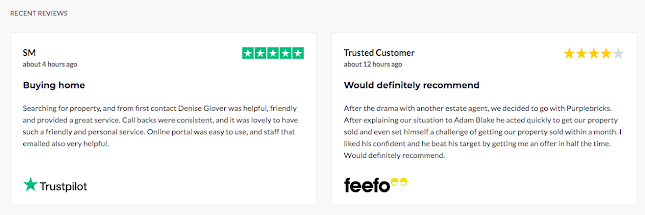
Here they are, today, on their own website...


Here on Feefo...


And on Trustpilot...


Why would Purplebricks - or any other business - use a review site?

The answer, we are afraid, is simple: it allows the business a degree of control over the following...

  • who is allowed to/invited to write a review: in order to write a review on Feefo you must receive a unique invitation from the business to be reviewed with an embedded link, for Trustpilot just the invitation (it is possible to visit Trustpilot to leave a review, and some people do, but most that don't receive that invitation and want their voices heard head straight to Google)
  • the date of that invitation
So: your business cares - quite rightly - about its online reputation. You look at the 'advantages' listed above and your first reaction? 'Great, we can control who writes reviews.' Unfortunately, that has two far-reaching consequences...

  1. It is illegal - it is in direct contravention of the UK's CMA's regulations which specifically state that 'a business that actively invites reviews must allow all of its customers to write a review' and that 'the business must not control the timing of the writing of that review.'
  2. It results in what - back in 2018 - we christened 'deflection'. It drives uninvited dissatisfied customers to write their reviews direct to Google.


So what does Purplebricks look like on Google?


It is also an unfortunate truth for businesses that employ review sites that Google reviews, in over 98 percent of cases, feature far more prominently in searches. They are shown front and centre for just about every business search.

Just look at this - or search for your own business...


What does the searcher see? Trustpilot reviews? No. Feefo reviews? No. Google reviews? You bet!

'But...' - we hear you say (and it is a big 'But') 'We have no control over who writes a Google review, and no recourse once a Google review, however unfair it may be, is written.' 

Funnily enough, this is where HelpHound comes in. Our core offering is moderation. 

What, exactly is moderation? It means first inviting the review to the business - via its website; this enables the independent moderator - Helphound, in this instance, - to check the review for factual errors or statements likely to mislead future readers. Far less than five percent of the reviews we see require moderation, but when they do it is often crucial: misunderstandings over billing, blaming the business when a third party was actually at fault, and so on. Reviews that, if published - either on the business's website or on Google (and we ask reviewers to do both - and about 50% do) can do untold harm, both to the business and to the consumer that may be put off using a business that is ideally suited to their needs.        

How do we enable businesses to comply with the CMA regulations and look good at the same time? The simplest answer is that we only work for great businesses, but even great businesses need moderation - because customer/client/patient misunderstandings will always arise. If you look at this example you will see what we mean: here's the business - a client of ours...


...and we know them well. They are a very experienced and dedicated team. But just once in a while, even they get a review that our moderators have cause to query - and in every case since they joined five years ago the review has either been re-written by the client before it was published or withdrawn. 

Once reviews are published on their website (498 there to date) the reviewer is automatically asked - by HelpHound - to copy their review to Google. As you can see 284 have done so. The combination of the business's professionalism and our moderation has them listed as the top business in their sector in local search (also helped, no doubt, by the SEO kicker provided by hosting their own reviews on their website). 

Most important of all, our moderation gives them the added confidence to invite reviews in the first place, in the certain knowledge that factually incorrect or potentially misleading (and, ultimately, potentially damaging) reviews will be challenged and - for the most part - corrected. 


And, by having the standing invitation on their website - see above - they comply with the law. They don't have to proactively ask 'Mr Angry' to write a review, but he can click and post one if he wants. That way at least they - and he - will benefit from moderation (you might be surprised to see just how many messages we see coming back from the reviewer - in private - saying things like 'Thanks for putting me straight' and 'I'm glad I had the opportunity to understand [X] before my review was published').


Conclusion

We are not suggesting that Purplebricks would have thrived as a business if it had focussed on Google reviews, just that it would at least have had reviews from those with a positive experience there for consumers to see. Moderation cannot magically make reviews from consumers who have had a negative experience go away, and nor should it, but, as we have said above, it does give the business the confidence to invite its customers to post reviews to Google.

The core message is that if reviews are important to your business, and if you are in the service sector: financial, legal, medical, marketing, recruitment and so on, they will be, we provide the most up-to-date, proven (see 'Results' below) and effective review management platform available today. And it won't cost your business the earth - almost certainly less than an equivalent business would be paying Feefo or Trustpilot.


Further reading...


Monday, 11 July 2022

'Indispensable'

That's how we were described by a client's head office - writing to one of their branch offices - just last week.

It's an interesting adjective. Here's the dictionary definition of its meaning...


So: how does something that many consider just a 'useful addition' become 'indispensable'?

Here's precisely how...

1.  Google reviews are everyone's holy grail these days, and rightly so, but inviting customers to post a review direct to Google involves a distinct element of risk. That risk is that a customer may post an inaccurate or otherwise misleading review. All businesses understand that negative reviews have the potential to cause significant harm - just read this horror story if you have any lingering doubts - and no compliant system can (or should) stop a purely negative review, but moderation is extremely effective at ensuring that reviews accurately reflect the customers' experience of any given business or transaction. 

2.  Moderation - the act of engaging with the customer after the review has been written but before it is posted publicly anywhere - is the only compliant way of ensuring that unfairly damaging reviews are posted, on a business's website or on Google. For moderation to work effectively - and have credibility - the business must employ a third-party. 

3.  An important side effect of moderation is that it enables the business to be compliant with the CMA rules - the law. CMA rules clearly state that a business, if it is to invite reviews at all, must...

    • allow every single customer to write a review...
    • ...at a time of their choosing 

Now, a business can be fully compliant with the CMA rules by importing Google reviews into its website and inviting them to be written from there. The issue then arises when the latest Google review is factually inaccurate or misleading - in other words: capable of unfairly influencing consumers against the business. Then the business realises it needed a moderated system.


It works!

HelpHound cannot provide an absolute guarantee against factually inaccurate or misleading reviews (aside from anything else that would flout the CMA regulations), but many years of results for our clients show that our moderation is over 97 percent effective in managing such reviews. Here are the statistics for just one multi-location client... 


Just to be crystal clear: over the period under consideration, many thousands of reviews went through the moderation process (every review submitted is moderated - read for factual errors or potentially misleading statements). Of those thousands, 173 were identified as containing wording that might be contentious in any of the following ways:

  • Personally abusive. Abuse helps no one, not the reader of the review, not the business under review, and almost certainly not the reviewer (who will often be writing the review in order to have their grievance addressed). In these cases, HelpHound will simply message the reviewer and ask them to rewrite their review.
  • Legally contentious. A review is not the arena to make threats of legal action. That should be done through the proper legal channels.
  • Factually incorrect. This covers the overwhelming majority of moderated reviews: the review simply contained a factually incorrect statement. In these instances HelpHound will refer the review to the business for comment and then relay that comment to the reviewer, in private. As you can see from the 'Not published as a result of moderation' and 'Modified...' numbers above this action works for the overwhelming majority of such reviews. What is interesting is just how grateful the great majority of reviewers are when they realise that their review had 'got the wrong end of what is often quite a complex stick'. As many readers will know, HelpHound's clients are, in the majority of cases, professional businesses dealing with complicated matters - often legal, financial and/or medical - and it is understandable that some reviews will initially reflect misunderstandings of such transactions.
  • Potentially misleading. In the most basic of senses: not all our client business's customers speak - or write - English as a first language. A review that simply doesn't make sense will be spotted by our moderators and they will engage with the reviewer in order to correct the use of language so everyone - again: the reader of the review and the business under review - benefits. Other examples include...
    • misunderstanding of contract terms/terms of business
    • misunderstanding of billing
    • misunderstanding of legal responsibilities
    • misunderstanding of tax implications
  • False or plain fake reviews*: these don't happen that often, but when they do it is essential that they are identified pre-publication; they may be written by competitors or ex-exployees or just by someone who has nothing better to do (here's an example of a viewer adversely reviewing accommodation that he had seen on TV; joking aside, the hotel's booking slumped as a direct consequence of that one review - until an appeal managed by HelpHound got it taken down).
*On that last subject - malicious (fake) reviews: while HelpHound will almost certainly identify and therefore challenge any such review written to the business's own website we cannot, for obvious reasons, do anything about such a review being written direct to Google. What we can do, as we did in the case of the hotel cited above, is draft an appeal to Google in a way that is most likely to have a chance of success.


The impact - in numbers

The difference between a business - that complies with the law - and a business employing professional review management:

Typical well-run business inviting reviews direct to Google...


Typical HelpHound client...


Important note: there are plenty of businesses out there that score well on Google, but when we meet them we inevitably discover that they are - inadvertently, in the main - flouting one or more of the CMA's core rules: they either cherry-pick happy customers to invite to write Google reviews or they 'gate' (gating being the act of pre-qualifying customers to identify those most likely to write a positive review). Not only are both these 'strategies' illegal, they will be obvious to competing businesses and therefore used against the non-compliant business in pitches.


To summarise...

  • All other factors being equal a business that employs independent review management will have a higher Google score than the equivalent - CMA compliant - business that does not
  • The business will be in full compliance with the CMA regulations - the law
  • Its potential customers will have accurate reviews - on the business's own website and on Google - to rely on
  • Enquiries, through both Google search and through its own website, will increase by a measurable amount (see the link directly below)

Further reading...

Wednesday, 16 February 2022

Why not Google?

 Here is a well-known and much-marketed national brand, on its own website:


Now, given that we all know that Google reviews are:

  • more visible - in all searches
  • more viewed by consumers
  • more credible - at least Google knows the online activity of the reviewer
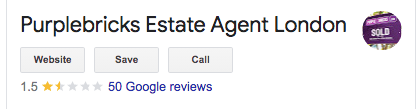
Why are they not promoting their Google reviews? Maybe the answer is here, in searches on their HQ...


...and London:


And here, with the second organic result when a potential customer searches for 'Purplebricks reviews':


Ouch! Three times ouch!

Now, we are not commenting on the effectiveness of the business. We've never used them. But we are commenting on the effectiveness of their review management strategy; it is misguided.

Why?

At the very least, employing not one but two review sites - why two, we have been asking ourselves and our readers for years? - has led unhappy customers to ignore the business's chosen channels and write their reviews to Google (and another review site). This is a well-known habit we christened 'deflection' (this article was written over 5 years ago).

Lessons for them - and everyone else

First and foremost: a business's review strategy should be based on and built around Google reviews, not any of the independent sites.

Next, if you run a complex service business such as an estate agency - or a financial, medical or legal practice, where your good reputation is a vital plank of your marketing* - you need an independently moderated system. This will ensure the bare minimum of inaccurate, misleading or just plain unfair reviews see the light of day.

Having accepted those two basic ingredients you will need to find someone like HelpHound so you can host your own reviews on your own website and have them moderated and as many as possible copied across to Google.

Back to the original question: why have Purplebricks not adopted such a strategy? We haven't the faintest idea. Please comment if you have.


The City knows what it's doing

Not always. But in this case it looks as if it does:


* 'Isn't every business's online reputation important?', we hear you ask, quite sensibly. Well no. High Street retail and quasi-monopoly businesses such as utilities will trade quite happily while their customers rate them 1* online. Think Starbucks or Vodafone. Definitively not the case for a solicitor or a gynaecologist - they have to look the best they possibly can; if you have any doubts at all please read this horrifying case history.


Thursday, 26 August 2021

Review denial - why?

We first wrote about this syndrome back in 2014 - who would have thought that there are still some corners of the marketing world where it persists in 2021?


This kind of Google entry is increasingly rare, simply because businesses cannot actively prevent anyone from leaving a Google review; more common are completely unmanaged listings such as the one below (this example is of a substantial London law firm, but it is reprsentative of many others)...


Now, we could fill this post with many more examples of businesses and professions that have yet to engage with Google reviews, but, since this article is aimed fairly and squarely at them it would probably be counter-productive. After all, they almost certainly know who they are.

So, let's first mine our decade-plus of experience and see if we can work out just what is holding them back.

Reasons we are given for not engaging with Google reviews

1.  We don't need any more business

2.  Our clients/patients will not want to be asked to write a publicly visible review

3.  The nature of our business - confidentialitysensitivity - precludes us from inviting our clients/patients for a review

4.  We are concerned that some reviewers - given the highly technical nature of our business - will write factually inaccurate or potentially misleading reviews

5.  None of our competitors have engaged with reviews

6.  We don't have the resources - human 

7.  We don't have the resources - financial

8.  We will go it alone 

9.  We have engaged - with a reviews site

10. We're not sure just how much value a professional review management strategy will add


Let's deal with these in order (you can skip to your favourite if you like):

1. 'Don't need any [more] business...'

Rare, admittedly, but we have encountered it. The kind of business that doesn't even have a website; after all, if a business is prepared to invest in having a website and the associated hosting fees, surely they must have done so with the intention of generating more business? And then - as reviews are proven beyond all doubt to produce more business - we have to conclude that any business with a website needs review management.

2.  'Client/patient will not want to write a review...'

Completely understandable. Until you look at similar businesses in 'sensitive' areas that have succeeded in engaging their clients or patients - how much more sensitive and confidential than womens' health can a service be? Yes, they will write reviews such as this one...


Remember that you will not be forcing or in any way coercing anyone into writing a review; in this context, the wording of the invitation email is essential (and we have years of experience in advising on this and seeing the positive real-world results).

3.  'Confidentiality precludes...'

This applies to so many essential services: legal, financial and medical are just the tip of a very large iceberg. Again, no one, least of all the business asking for the review, will be asking anyone to divulge any confidential information* - even their real name (avatars are acceptable - only Google/HelpHound will hold their email address); and you won't be pathfinding on behalf of your profession, the concept of reviews has been proven beyond any reasonable doubt, in every sphere of business.

*every single review written through HelpHound is moderated for factual inaccuracy, potentially misleading statements and disclosure of potentially confidential information before it is published on the business's website, let alone to Google.

4.  'Factually inaccurate or potentially misleading...'

This is the one single factor that most often prevents professional businesses from enaging with reviews. Either that or they take the chance that the CMA won't descend on them for cherry-picking happy customers to write reviews (see 'CMA core regulations' link under 8. below). 

These kinds of review benefit no one - the business under review, the potential client relying on the review or the reviewer themselves, and that's one of the main reasons why businesses engage HelpHound: every review HelpHound publishes on a business's website is moderated beforehand: checked for factual inaccuracies and potentially misleading statements. Only then is the reviewer invited to copy their review to Google.

5.  'None of our competitors...'

Highly unlikely, but in the event that you operate in such a rarified environment wouldn't it be a great idea to be the first?

6/7.  'We don't have the human/financial resources...'

To increase incoming enquiries by 20-30 percent? We positively guarantee that professional review management will more than pay for whatever resources you devote to it. And adding HelpHound to oversee your engagement with Google reviews will cost little more than a decent mobile phone contract per location.

8.  'We will go it alone...'

Fine. Better than doing nothing - perhaps. But, as with any professional adviser, HelpHound expects the rewards for its clients to far and away exceed the cost, always. Just read 'Results with a capital R' and we're sure you will see what we mean.

Oh! and by the way, most businesses that have developed an independent strategy with Google reviews are in breach of one or more of the CMA's core regulations - almost always unwittingly (not that that will influence the CMA's enforcement teams!).

On top of this, the benefits of hosting your own reviews on your own website are now proven beyond all doubt: the obvious being that consumers can read reviews there without resorting to Google where they will be shown reviews of your competiors; the less obvious, but no less important benfit being that hosting your own reviews gives you SEO credit with Google and enables them to be moderated, thereby reducing the chances that an inaccurate or misleading review sees the light of day - on your site or on Google.

9.  'We have engaged a review site...'

This is a tricky one; review sites did have a role to play before Google became so overwhelmingly dominant in the review space, now, with very few exceptions, businesses are better advised to go down the Google route. First, just google your own business and then, for good measure, google a competitor: what do you see? Yes, Google reviews. Then, as if that were not convincing enough, ask yourself, would my business rather have 100 Google reviews or 100 on [ABC review site]? For an even more detailed answer to that question read this article.

10. 'Value added...'

Read this comment made by a client of one of our clients. 

As the lawyers in the example at the top of this article might say: 'We rest our case'.

Monday, 24 May 2021

HelpHound - adding even more value in 2021

We are very proud indeed of what we continue to achieve for our clients, so here's our pitch to those businesses yet to join:


And broken down, phrase by phrase:

1.  'Quantifiably better off':

Professional review management pays off in so many ways; with some of these - staff morale and the like - you will simply be relying on feedback, both verbal and written, but with core business drivers such as calls and clicks through Google and your own website you will be able to see and track accurate numbers and uplifts.

You will be able to measure exactly how many more clicks and calls you receive. How? By referring to your monthly Google My Business report in the weeks and months after you join. Here's a screenshot of a typical client's report taken within weeks of joining:


To be clear: this GMB report shows an uplift in calls and clicks through Google for the month in question. The numbers are great (most businesses would probably be happy with uplifts like this over a year, let alone a month), and I'm sure your business would be happy with them; the best ever Google My Business report a client has ever shown us reported month-on-month uplifts of 169% and 950% respectively!

What value would your business place on an uplift in enquiries such as this? And if your business already looks great on Google? Read points 3, 6 and 7 that follow below with special care.


2.   'More enquiries through Google':

See above. And a great score + great reviews = more calls and more clicks = more leads = more business.

And see point 6 below: 'Looking great in all types of Google search'. It is also crucial your business looks good compared with its competitors without flouting the law (see point 7.)


3.  'More enquiries through your own website':

It's the number one objective of most business owners when they brief their web designers...
  • 'generate more leads/enquiries/contacts'


It is also now a universally acknowledged truth that hosting independently verified reviews on your own website drives those enquiries (and reinforces all your other marketing). If in any doubt we suggest you speak to a HelpHound client - or, better still, try it for your own business (see the end of this article for a suggested trial). 

Just ask yourself 'How would our potential customers react to seeing independently verified reviews like those shown in this article on our website?' How could the response to that question be anything but 'positively'?


4.  'CRM enhanced':

Hosting a 'Write a review' button on your website has many CRM benefits: It allows all your stakeholders - customers, existing customers, past customers - to express their satisfaction with your service, publicly. It also gives those with an issue to resolve a non-confrontational way to contact you - in preference to simply resorting to posting a potentially damaging review direct to Google, for instance.

Built into HelpHound, unlike the major review sites (Yelp, Trustpilot, Feefo etc.), is moderation: every single review that flows through our mechanism to your website and then on to Google is read and checked for factual inaccuracies and statements likely to mislead future customers. If we find either, or in some instances both, we refer back to the reviewer and the business so they can be corrected. This is hugely popular with both reviewers and businesses under review; it also makes the ultimate reviews so much more reliable for readers: your future customers.


5.  'Staff morale boosted':


This kind of review - on Google:


And this* - on the business's own website:


Who doesn't like seeing comments such as this? Besides being enormously reassuring for prospective customers (in this case patients of a Harley Street GP client of ours) comments like this tell staff that their services are valued in a way few other mechanisms can. 

And: would you rather have this comment in a private email, or on Google and your own website?

*We are sometimes asked why we allow reviewers to identify themselves by a first name or nickname. The reviews by 'Debra' above serve to illustrate this: would you post a review of a medically, legally or financially sensitive nature using your full name? No, of course not. Bear in mind that both we and Google have the reviewer's email address, and are therefore - in the case of HelpHound - able to contact them if needs be.


6.  'Great in all types of Google search':

Look at this local search:


Probably the most commercially important search of all for many businesses is local search: when a potential customer is most likely to be influenced by the business's reviews, review score and 'stars in search'. 

The three businesses in the Google 3-pack all look good, with the same scores and credible amounts of reviews. 

We generally advise clients to aim to achieve at least 50 Google reviews as quickly as possible, with 100 as the next target; just think from the reader/potential customer's point-of view: under 10 reviews: meaningless; 11-20: written by their friends and staff; 21-50: how difficult can it be to find that many happy customers? 100+ now we're talking.

The score/'rating' (4.8), reviews/'votes' (204) and five gold stars under Winkworth's organic listing are taken directly from the business's own website and from the reviews hosted there, not from their Google reviews and scores.

Now, we cannot guarantee a business will come anywhere in a given Google search, but what we can tell you is that...
  • this client business had appeared as one of the three businesses (out of over twenty) in the Google three-pack for this location for over three years now
  • it has led the results in natural - also known as organic - search for thirty-one of the last thirty-six months (and has come second or third for the remainder)
  • it has been the only business with an attributed rating - the '4.9 - 212 votes' and accompanying stars, all derived from the reviews hosted on their own site for the overwhelming majority of that period

And this 'specific' search:


This is the kind of search performed by consumers when they need any information about a business. When they need to find the business's website or even its phone number. It is a great opportunity to impress and reinforce (and there's no coincidence that Google devotes so much of the search real estate to review and review scores; in this search alone reviews are highlighted by Google's use of gold stars no less than seven times).

Again: the 'Rating' (4.9) and the number of reviews (212) are pulled from the business's own reviews hosted on their own website - shown three times in this search, as distinct from their Google reviews (140) at the top of their Google knowledge panel on the right, most of which have also been reposted from the reviews written to their website. 

The 'Reviews from the web' link at centre right links directly through to the reviews hosted on the business's own website.


7.  'Compliant with the law':


It is illegal to selectively invite customers to write reviews. So businesses either flout the law and only invite customers who they know are most likely to write a 5* review or they shy away from inviting reviews altogether.

Those in the first category are inviting action by the CMA (and will lose business to competitors savvy enough to alert potential customers to their rule-breaking behaviour), those in the second are missing out on a fantastic marketing opportunity. HelpHound's independent moderation is the answer to both.

All a business needs to be instantly compliant is to have the 'Write a review' button you see at the top right above embedded in its website. The 'What is HelpHound' link at the bottom of this screenshot leads directly to a description of our relationship with the business under review. If you would like to see all of this in action just click here.


The next step

We urge you to spend just five minutes performing the two searches for the businesses referred to in this article...
  • Winkworth estate agents in Blackheath
  • The Harper Clinic in Harley Street
...so you can see the impact HelpHound has had on the impression created for those businesses on both Google and their own websites.

Then, if you are reading this and your business is yet to benefit from HelpHound's services we then suggest that you call or email to arrange to speak to one of our highly experienced staff (you won't be speaking to anyone with less than ten years experience of review management and HelpHound's services).


Further reading:
  • Results - expanding on point 1
  • Compliance - all you need to know about this crucial subject
  • ABC of Reviews - index to all eleven chapters describing review management in detail.
  • Moderation - protecting your business from all kinds of inaccurate or misleading - even fake - reviews
  • Deflection - the unintended pitfalls and consequences of using a review site, as opposed to review management