
Showing posts with label OnTheMarket. Show all posts

Monday, 7 March 2022

Trustpilot: yet another question


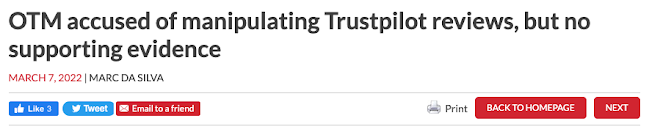
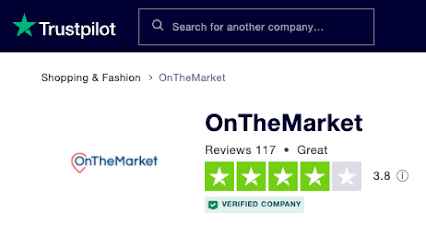
This article appeared today. So we had a look at the listing it refers to:


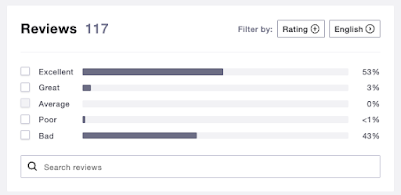
And then we checked the underlying reviews by score:


Which raised a wholly different question: how on earth does a business that has 43 percent of its reviews scoring 'Bad' (rated the lowest: one star) get a 4-star rating from Trustpilot with the accompanying accolade of 'Great'?

What we can tell you is that based on the spread of reviews shown above, both HelpHound and Google would score the business at 3.2, giving a Trustpilot rating of 'Average'. 

Trustpilot, in their explanation of their scoring system state as follows:
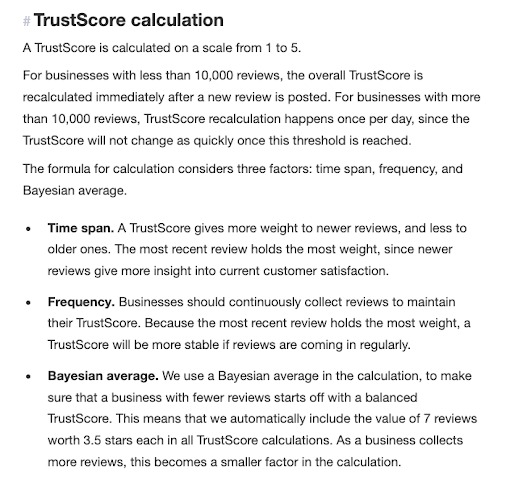

We would comment on each of these bullet points:

  • Weighting more recent reviews. We would recommend that any review system that is going to stray from an unweighted mathematical calculation completely discount reviews that are over three years old; part of the point of reviews is that businesses should learn from them and therefore consumers should be given a snapshot of the business as it currently is, not skewed by ancient reviews. In the case of OnTheMarket, they have received 11 five-star reviews and 8 one-star reviews since 1 January 2022; any 'weighting' would struggle to find a positive outcome from those stats.
  • Frequency. We have no argument in principle, but the basis of calculation or weighting should be clear. We have no clue what the sentence 'Because the most recent review holds more weight, a TrustScore will be more stable if reviews are coming in regularly.' means.
  • Bayesian average. Fortuitously one of our directors used to work at HM Treasury and so is familiar with Bayesian averages. He has explained that these are usually used to smooth statistical subsets; he says that the application of a Bayesian average cannot explain why a business that should be scoring 3.2 might suddenly score 3.8. For those of a mathematical bent here is the Wikipedia entry for Bayesian averages.

Here's their star rating and 'Excellent/Great/Good/Average/Poor/Bad' matrix:
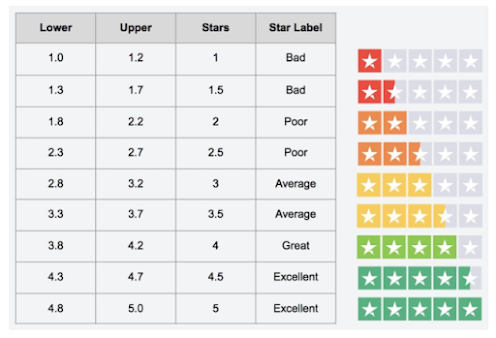


Which illustrates the difficulty - for the consumer - inherent in such a system. Any business scoring in the range 3.8 - 4.2 is 'labelled' 'Great'. Seriously? Such a business is likely to be rated at 1* by at least twenty percent of its customers (Bayesian average or not). Would you use a doctor/lawyer/financial adviser where one in five of their customers rated them one star, bearing in mind a business cannot be rated 0 stars?

Last, but not least, this:
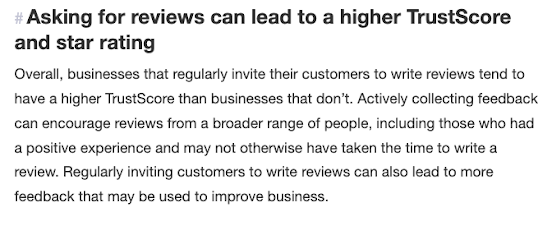


We have no argument with the last line, but the rest? Really? Well, yes, in the case of Trustpilot. Businesses paying Trustpilot do score better than those that don't. But that's the same with any review system - businesses that are passive invariably pick up 1* reviews from unhappy customers as they are so much more motivated. HelpHound clients invariably score 4.5+ but that's because they are excellent businesses with dedicated CRM. But, as all our regular readers know, we advise our clients to focus their efforts on their own websites and Google - in other words, where their reviews will be seen.


In Conclusion

It's best to let consumers read reviews and make up their own minds, by reading the individual reviews in conjunction with an 'unmanipulated' score, as to whether the business is good or not.

Monday, 9 February 2015

OnTheMarket - our take


One advantage we may have at HelpHound is that we are not industry insiders, but we do meet a lot of people in the industry. This sometimes gives us a slightly more detached and objective view (we hope). So what do we see when we look at all the comments flying around about OnTheMarket?

For the last three months we have been conducting a straw poll accross every client or prospective client we have met, and the results were enlightening (to us, at least). There were definitely two ends to the spectrum: some used every portal they could lay their hands on and swore by that strategy, others virtually ignored portals and claimed that their clients simply were not interested in the 'how' as long as the 'when' was right. 

There were a large proportion who had no problem with the OnTheMarket 'one other portal' rule as they were only using one (usually, but not always, RightMove or Zoopla). Where were they going post launch? If there was a pattern it was independents for RightMove and corporates for Zoopla.

But the main message was 'don't let all the fuss-and-bother about portals give you the impression that they are the be-all and end-all of estate agency'.

Let's stand back and look at estate agency...

From the consumer's point-of-view:

Sellers/Landlords...
  • Sellers want the best price possible, usually (but not always) in the shortest time frame
  • Landlords want the highest rent possible with minimum voids
Do they really care how these are achieved? No. Do they know the difference between RightMove and Zoopla (or OnTheMarket)? Not always. Do they want to know? Mostly: not a lot.

So what do they want to know? They want to know that their agent is good at what they do, is professional, is responsive, has great local contacts and knowledge (and all the other good stuff we wrote about here). From the web point-of-view, when their property is listed they want to see it returned in search. Any search.

Find them a buyer/tenant (at the right price) and they're happy, often very happy.*

Buyers/tenants...

Want the right home, with the right facilities, in the right location, at the right (keenest) price. They really don't care where or how they find it (or who sells/rents it to them). They have little or no loyalty to any agent, let alone any portal. 

They can be, however, grateful almost to the point of irrationality to the agent who finds them the right property.*

Our conclusion...

...is that some agents risk making far too much noise about portals when they should be thumping their own drum - promoting their own expertise. Acknowledge that portals have a role to play, but major on the service aspects of your role. 

Use reviews to demonstrate that you are great at what you do, not because you say so (or that carefully selected clients say so) but because your clients say so (and they're all invited to do so).


Why the asterisks above? Because those are the people who are going to sell your service for you: happy buyers and sellers, happy landlords and tenants. They are going to write great reviews for you and we bet they never mention a portal when they do!