Friday, 22 July 2022

Online reviews - the BASIC basics

The most recent article on here is entitled 'Online reviews - the basics'.  We commend it to you if you have fifteen minutes to spare, and it will surely repay you a hundredfold, even if you were previously unaware of just one of the 12 points we made there.

But some people - completely understandably - want something brief. Punchy even! So here goes...


Q1.  What reviews do we need?

A: Google reviews. Not Trustpilot. Not Feefo. Not Yelp. Not Reviews.io. Why? Because Google reviews always appear every time someone searches on your business - or your type of business.

Note: if you have any doubt about this just look at the share price history of the two biggest quoted review sites. Yelp peaked at $97 in 2014 and trades at $31 today. Trustpilot peaked at £4.81 in September last year and trades at 71p today. Ouch! 


Q2. Where do we need them?

A: On Google and on your own website. Customers increasingly rely on reviews - so why not give them reviews where they can easily see - and read - them?

Note: Just search and see. Try the local search 'estate agent Blackheath' and then the specific search 'Winkworth Blackheath'. Then check out the business's website and see how impressive their reviews look there.


Q3. Can we get them for free in both locations?

A: Yes. Invite customers to write reviews to Google and display them on your website using any one of the free widgets out there (an online search for Google review widget/plugin will throw them up - but don't respond to any of the ads - best of all consult your web designer).

Note: As with anything that's free in life, be wary. Read all about moderation in Qs 4 & 5.


Q4. Why might we need HelpHound's moderation?

A: If you are happy with a Google score of 4.3 you don't. If, in addition, you are prepared to break the law and only invite 'happy' customers to post reviews to Google you may even score 4.8. If you are prepared to go further down the illegal road and 'gate' (prequalify) you will score 4.9 or even 5.0. 

Note: if you break the law you won't only be running the risk of being noticed by the regulators (the CMA), you will undoubtedly be spotted by your sharpest competitors. Don't hand them a win.


Q5. Right, so what kind of business needs moderation?

Professional businesses and businesses that deal with complex issues. Financial, medical, legal and the like.  Any business that calls its customers 'clients' or 'patients' is useful shorthand. Why? Because customers of these kinds of businesses can easily misunderstand matters and write factually inaccurate or potentially misleading reviews.

Note: We keep a record of the numbers of reviews moderated on behalf of our clients; our moderation enables a potentially harmful inaccurate or misleading review to be corrected before it goes live at least once every six months for a typical client.


Need more? Call us.


Further reading...

Here are some useful articles that will take you deeper into the science of review management...

  1. Results. Review management pays for itself. Here's how.
  2. Moderation: the keystone of review management.
  3. Compliance. Why not be compliant with UK law?
  4. 'Killer' reviews - examples of single reviews that stop the phone ringing.
  5. A shocking case history - where the business took on the review site and the reviewer

Wednesday, 13 July 2022

Online reviews - the basics

A new client reminded us that some people are still on first base regarding reviews and that we haven't written a 'beginners guide' for quite some time. Here we address all the questions someone coming new to the subject of online reviews might have - if you have any that aren't answered here please let us know and we'll add them in.

1.  Who reads reviews?


The simple answer? Everyone. Why? Because they are placed front-and-centre of every Google search. And that in itself tells you a lot: if Google are putting such value on reviews we know that it knows consumers are a) reading them and b) acting on what they read.

2.  Who writes reviews?


You might be surprised. It is far too easy to fall into the trap of thinking that those who write reviews are lonely people with far too much time on their hands; review writers come from across the spectrum.  But, in a way, it doesn't matter who thy are, because, taken together, they have immense power - to drive business towards or away from any given business. As the graphic above says: ask and you will receive.


We include this review to show you that businesses that provide great service - even in such a sensitive area as this, will attract reviews, providing the invitation is worded sensitively. And how valuable must such a review be to people in a similar situation?


3.  Do reviews have credibility?


Again, this can be argued until the cows come home. The fact is that the more urgent the need and the more complex the issue, the more people rely on reviews. Shirts and socks? Not so much. Health, finance and legal? Far more so.


4.  What impact will 'opting in' with reviews have on our business?

It will light up your online shop window. No matter how much marketing and PR a business does, at the end of the day it's going to be searched for online - even if that's simply to find an address or phone number. At that point the potential customer is going to see reviews - Google reviews - and they will read them, it's only human nature.

From a statistical point of view we tend to advise businesses to expect an uplift in enquiries - through both their website and Google search - of between 8 and 15 percent. Some experience far more than that, but none experience a fall. Adopting moderated review management is a win/win all the way.


5.  How can we measure this?


Every month Google sends your business a report. In that report are the hard numbers for the calls and clicks you've received in the previous month. These will reflect any uplift as a result of your online efforts, including reviews. The image above is a screenshot of a client's first Google My Business report post-adoption. It shows a remarkable uplift in calls and clicks through to their website - +18% and +27% respectively; you can see the results in your own GMB report, every month.


6.  What about all the review sites?


Google reviews only came to prominence after the review sites had been founded - the likes of Yelp, Trustpilot, Reviews.io and Feefo all preceded Google reviews. Now the review sites offer no added value for a business: they are less visible and less credible. Ultimately all business needs to do is ask itself 'Would we rather have 100/1000 Google reviews or the same number on [Trustpilot/Feefo...]? 


7.  What can we do if we get an unfair or inaccurate negative review?

Google has very tight guidelines for appeals against reviews. That is why moderation - see 8. below, is so important. We conduct Google appeals on behalf of clients all the time and some do succeed, but it is important that businesses employ some kind of moderation in order that factually inaccurate or potentially misleading reviews are spotted before they reach Google.


8.  How does moderation work?

The review is written to the business's website. HelpHound reads the review before it is published and reverts to both business and reviewer if there is any contentious content. In order to be compliant with the CMA regulations the reviewer retains the right to have whatever review they want published, at any time during or after this process. Here's an example of moderation in action...


At any time during this process, or at any time subsequently, the reviewer could publish their review - or an amended version of it. The fact that few choose to do so is a reflection of the efficacy of moderation in resolving misunderstandings.


9.  What impact will hosting reviews on our website have?


Consumers want reviews; of that there is no longer any shadow of a doubt. So modern businesses show reviews, prominently. And enquiries flow as a result.


10.  How will we get stars in Google search?


Here's a typical local search on Google; the stars next to Winkworth Blackheath relate the score and reviews hosted on its website, not its Google reviews and score.

This is where your web designer comes in. We provide them the API and they implement it in such a way as the Google schema pulls the ranking we show on your site through to search.


11.  Why not go direct to Google?

Indeed. If you are happy to score 4.3 and have 5-15 percent of your reviews rating your business at one star then by all means focus on Google without moderation. But if your competitors are scoring 4.8 - by fair means or foul* - you will need a moderated system.

If you work in sensitive professions - medical, legal, financial and so on, where multiple reviews are read by consumers before making their initial enquiry it is vital to minimise the number of factually inaccurate or misleading reviews. And not just for your business's sake but for the sake of your future customers/clients/patients who may otherwise be put off taking the next step towards using your services.


12.  *Fair or foul?

It is illegal - in the UK anyway - to...

    • selectively invite customers to write reviews
    • control the timing of such an invitation
    • perform any action to establish whether or not a customer is likely to write a 5* review before inviting those who do so to write one (known as 'gating')

But that doesn't mean that many businesses don't do exactly this: in our experience the overwhelming majority of businesses do, wittingly or unwittingly. Moderation gives such businesses the comfort that they won't be breaking the law in future.


Thats all. As we said at the start, please don't hesitate to contact us if you have any questions - through this blog or direct at info@helphound.com or by phoning 020 7100-2233. 

Monday, 11 July 2022

'Indispensable'

That's how we were described by a client's head office - writing to one of their branch offices - just last week.

It's an interesting adjective. Here's the dictionary definition of its meaning...


So: how does something that many consider just a 'useful addition' become 'indispensable'?

Here's precisely how...

1.  Google reviews are everyone's holy grail these days, and rightly so, but inviting customers to post a review direct to Google involves a distinct element of risk. That risk is that a customer may post an inaccurate or otherwise misleading review. All businesses understand that negative reviews have the potential to cause significant harm - just read this horror story if you have any lingering doubts - and no compliant system can (or should) stop a purely negative review, but moderation is extremely effective at ensuring that reviews accurately reflect the customers' experience of any given business or transaction. 

2.  Moderation - the act of engaging with the customer after the review has been written but before it is posted publicly anywhere - is the only compliant way of ensuring that unfairly damaging reviews are posted, on a business's website or on Google. For moderation to work effectively - and have credibility - the business must employ a third-party. 

3.  An important side effect of moderation is that it enables the business to be compliant with the CMA rules - the law. CMA rules clearly state that a business, if it is to invite reviews at all, must...

    • allow every single customer to write a review...
    • ...at a time of their choosing 

Now, a business can be fully compliant with the CMA rules by importing Google reviews into its website and inviting them to be written from there. The issue then arises when the latest Google review is factually inaccurate or misleading - in other words: capable of unfairly influencing consumers against the business. Then the business realises it needed a moderated system.


It works!

HelpHound cannot provide an absolute guarantee against factually inaccurate or misleading reviews (aside from anything else that would flout the CMA regulations), but many years of results for our clients show that our moderation is over 97 percent effective in managing such reviews. Here are the statistics for just one multi-location client... 


Just to be crystal clear: over the period under consideration, many thousands of reviews went through the moderation process (every review submitted is moderated - read for factual errors or potentially misleading statements). Of those thousands, 173 were identified as containing wording that might be contentious in any of the following ways:

  • Personally abusive. Abuse helps no one, not the reader of the review, not the business under review, and almost certainly not the reviewer (who will often be writing the review in order to have their grievance addressed). In these cases, HelpHound will simply message the reviewer and ask them to rewrite their review.
  • Legally contentious. A review is not the arena to make threats of legal action. That should be done through the proper legal channels.
  • Factually incorrect. This covers the overwhelming majority of moderated reviews: the review simply contained a factually incorrect statement. In these instances HelpHound will refer the review to the business for comment and then relay that comment to the reviewer, in private. As you can see from the 'Not published as a result of moderation' and 'Modified...' numbers above this action works for the overwhelming majority of such reviews. What is interesting is just how grateful the great majority of reviewers are when they realise that their review had 'got the wrong end of what is often quite a complex stick'. As many readers will know, HelpHound's clients are, in the majority of cases, professional businesses dealing with complicated matters - often legal, financial and/or medical - and it is understandable that some reviews will initially reflect misunderstandings of such transactions.
  • Potentially misleading. In the most basic of senses: not all our client business's customers speak - or write - English as a first language. A review that simply doesn't make sense will be spotted by our moderators and they will engage with the reviewer in order to correct the use of language so everyone - again: the reader of the review and the business under review - benefits. Other examples include...
    • misunderstanding of contract terms/terms of business
    • misunderstanding of billing
    • misunderstanding of legal responsibilities
    • misunderstanding of tax implications
  • False or plain fake reviews*: these don't happen that often, but when they do it is essential that they are identified pre-publication; they may be written by competitors or ex-exployees or just by someone who has nothing better to do (here's an example of a viewer adversely reviewing accommodation that he had seen on TV; joking aside, the hotel's booking slumped as a direct consequence of that one review - until an appeal managed by HelpHound got it taken down).
*On that last subject - malicious (fake) reviews: while HelpHound will almost certainly identify and therefore challenge any such review written to the business's own website we cannot, for obvious reasons, do anything about such a review being written direct to Google. What we can do, as we did in the case of the hotel cited above, is draft an appeal to Google in a way that is most likely to have a chance of success.


The impact - in numbers

The difference between a business - that complies with the law - and a business employing professional review management:

Typical well-run business inviting reviews direct to Google...


Typical HelpHound client...


Important note: there are plenty of businesses out there that score well on Google, but when we meet them we inevitably discover that they are - inadvertently, in the main - flouting one or more of the CMA's core rules: they either cherry-pick happy customers to invite to write Google reviews or they 'gate' (gating being the act of pre-qualifying customers to identify those most likely to write a positive review). Not only are both these 'strategies' illegal, they will be obvious to competing businesses and therefore used against the non-compliant business in pitches.


To summarise...

  • All other factors being equal a business that employs independent review management will have a higher Google score than the equivalent - CMA compliant - business that does not
  • The business will be in full compliance with the CMA regulations - the law
  • Its potential customers will have accurate reviews - on the business's own website and on Google - to rely on
  • Enquiries, through both Google search and through its own website, will increase by a measurable amount (see the link directly below)

Further reading...

Tuesday, 28 June 2022

Google under fire for search


Google came in for criticism in the Sunday Times this week - rightly or wrongly - that it is returning irrelevant sites for given searches as well as too many ads. 

Our feeling is - having seen some of the examples given in the article - that some critics are expecting Google's algorithm to perform some impossible mind-reading. How's this search string - 'poop coming from shower drain bad what to do' - from The Atlantic contributor Charlie Warzel of Galaxy Brain. Not quite in the same league, English-wise, of past Atlantic contributors Ernest Hemingway and Sylvia Plath? When we performed this search we got no ads and these organic results...


Not bad, considering. And we looked through the sites and blogs returned and, to be honest, we found the quality - in terms of helpfulness - to be pretty good.

Others are criticising Google for too many ads. Here's Diasuke Wakbayashi, who covers Google for the New York Times, searching for a hearing aids for his father: 'I was stunned by the number of ads'.  Here we go again...3 ads at the top, 3 at the foot of page one, bracketing the usual - and expected - 10 organic/natural searches, map search and dictionary definition. The same as for any other 'commercial' search.

There is an issue here, for businesses - and we're mildly surprised it wasn't addressed by the Sunday Times (although they did report Google's ad revenue fro 2020 at £147 billion) and that is 'how to appear in search without spending money on Google ads?'

And this is where HelpHound comes in. Our core role is to enable businesses to safely invite, moderate and display reviews on their own websites and then get as many of those reviews as possible copied across to Google by the reviewer. But what does that have to do with visibility in search? Our answer is twofold.


First - the simple part. Google displays reviews in search in two ways. The first we all know about - Google reviews...


The second all HelpHound clients know about: their own review scores appearing, along with their own reviews' star rating, in searches.


Including in the vital local search...


There is one key aspect of this where Google could be vulnerable to criticism: the fact that local (or generic) search results are ranked by SEO - in plain English: how well the business's website is designed and constructed, not on how good the business is at what it does. 

While we are astonished at just how many times we still encounter businesses that complain that 'we are the best in the area but so-and-so [competitor] always ranks higher in organic search' (and when we look at the business's website? It's not optimised for search) we are also mildly surprised that the business doesn't realise that Google gives it credit for hosting its own reviews. Here's a simple Google search...


The web is awash with articles on the subject...


...but your business can simplify Google's job no end - and increase your ranking in local search - by making sure your website is fully up-to-date and optimised and hosting and displaying reviews.

Just look at the example we've used above: Winkworth in Blackheath. They have accumulated nearly 250 reviews on their own site and have got nearly 150 of them across to Google. Guess where they appear in local search?


  • TOP - of the Google Maps search (what we used to call the 3-pack)
  • TOP - of Google's organic search - with 5 glowing gold stars
And do they need to pay for Google ads?


  • No they don't!
And finally - Google's share of the UK search market?


So: get Google right and you've got search cracked.


Friday, 10 June 2022

HelpHound - reasons to join, updated for 2022

It's a while since we focussed on us! So here's a reminder for clients - some of whom may be unaware of all the services we provide these days - and an unashamed pitch to everyone else who is yet to join.

1.  Results

Why do anything in business without being as sure as possible of the financial returns? Not a bad mantra really.

The results HelpHound provides for its clients are measurable - within weeks of joining. How so? Each month your business receives a report from Google detailing, amongst other things:


  • how many potential customers found your business in Google search and called you
  • how many potential customers found your business in Google search and clicked through to your website

For full details read this article. But for now we think these two anecdotes sum up the value we add pretty well. The first is a report by a client of a client of ours...


The second is an analysis of another two locations of that same client by a direct competitor commenting on an industry forum..


We think that, combined, these speak for themselves.


2. Safety - and boring old compliance

HelpHound pays for itself over and over again where high-quality professional businesses are concerned. Nothing stops inbound enquiries faster than a factually incorrect or potentially misleading Google review. And the only way to ensure your business gets the absolute minimum of these? Moderation. And the only way to have your reviews moderated? By inviting them to your own website in the first place.

Case history 1

Anyone who doubts the impact such a review can - and will - have should read this horror story: it's about a law firm that lost so many enquiries thanks to just one such review that they felt they had no alternative but to take the reviewer to court. They won - or did they? 

Case history 2 

We have a client that conducted an experiment: what if they simply bypassed moderation and embedded a Google widget to feed - and invite - Google reviews direct to their website(s)?

Sounds great? Save all the hassle of having to get the client to copy the review they've already written on the business's website over to Google. Bound to get more Google reviews that way - and the Google widget has the same SEO impact, right? And it's CMA compliant.  

All went swimmingly until unhappy consumers began to find the 'Write a [Google] review' button on their websites. Within six months nearly half of the locations involved in the experiment were showing a damaging 1* review front and centre on their websites' home pages. 

Now, there's being open and there's being rash. We suppose it would be kind of OK if the 1* reviews that appeared there were fair and balanced assessments of the service the business had provided, but the overwhelming majority were not, they were just the kind of reviews that would have previously benefitted most from our moderation: mistaken, wrong-end-of-the-stick, inaccurate and potentially misleading - sometimes one of these, more often a handful.

The business is in the process of unwinding the damage done. Not quite as simple as replacing the Google widget with the HelpHound moderated mechanism (there are compliance and SEO issues at play), but we're getting there.

Compliance

Yawn. Until you begin losing business because a competitor has spotted that you are selectively inviting Google reviews (illegal) or only showing 5* reviews on your website (also illegal). Then you will suddenly want to be compliant. All of our clients are complaint from day one. To continue the sleep analogy: they can all sleep soundly in their beds at night knowing they are not vulnerable to criticism by anyone, including the CMA.


3.  Service - we're here when you need us

See 'Safety' above. We have so much experience - just see how far back this blog goes and how many articles there are - and all of it is here for our clients to use. Seen a new review site and want to know if it will suit your business? Ask us, and we will know all about it. Have a review you are having trouble finding just the right response to? We'll have seen one just like it. Have a Google review you think is unfair or inaccurate? We'll know exactly how to draft an appeal to Google.

N.B.  We hope you never need any of the above, and I'm sure you do as well, but when you do need help - and the phones have stopped ringing - you will then be sure to understand the value of our service and the decades of knowledge behind it.


4. Total coverage - we know the mechanisms and the marketplace

We didn't just invent review management - although we did! - we stay abreast of every single development in the world of reviews (just put 'Trustpilot' into the search box on this blog, and we're sure you will see what we mean). And there's an awful lot to know about that you don't want to be bothered with. Think of us in the same way as you do your lawyers - we're there to provide specialist knowledge and advice exactly when it's needed, not software (that's a given) but person-to-person specific and targeted advice.

Monday, 6 June 2022

Purplebricks - a condemnation of review sites

 This article appeared on Property Industry Eye this morning...


But, should you look at Purplebricks' review sites of choice...


But, you may well say, those scores - 4.4 from Trustpilot and 4.5 from Feefo - are more than respectable. Why are allAgents so hard on them and why does Purplebricks accept it needs to improve 'quality of service to our customers'? Maybe a look at their Google scores - where they are available - may help?

Here's London...


And their HQ in Solihull...


Oh! - and here's another review site that they don't belong to...


And the aforementioned allAgents...


Now, we don't propose to go into any more in-depth analysis of the whys and wherefores of all the above, simply because we think we've already given most people enough information to come to the conclusion that subscribing to a review site can make even a business that rates so low on Google and other review sites look great. 

There is only one review mechanism that is open to all without interference from the business under review and that's Google. And our sincerely held view is that consumers are best served by reading a business's Google reviews and being guided by a business's Google score.

That goes for businesses as well: how can you justify - to the regulators, to your potential customers - using any other review mechanism but Google?

Google also happens to be seen by everyone when they search - that's unless the business has made strenuous efforts to make its Google reviews as invisible as possible. So why would a business pay for a review solution that comes a very poor second - in terms of both visibility and credibility (not to mention transparency) - to Google reviews?

Wednesday, 25 May 2022

Six questions answered

To save you mining through this blog, here are the six questions we are asked the most, along with our answers...


1.  Why not just invite customers to write Google reviews direct?

You can. If your Google score is not critical then by all means do. But don't be surprised when you receive the odd factually inaccurate or potentially misleading review (see 'moderation' at 4. below). It is easy to see one's own Google score in isolation, but potential customers will always compare your score with competitors. Look at these two searches (the first is a 'simple' search and the second has used Google's popular 'Top-rated' function)...


That 0.1 or 0.2 is only gained by using a moderated solution (or, dare we say it, playing fast and loose with point 5. below), and moderation is only possible if you invite reviews to your own website using an independent mechanism that incorporates moderation (such as HelpHound). 

As a general rule-of-thumb...

    • if you sell products: inviting reviews direct to Google will do the trick as a score of 3.5 - 4.0 won't put many customers off
    • if you sell a service: (legal, financial or medical and the likes of recruitment and estate agency) a single inaccurate or misleading review can - and will - do untold damage, so you will need a moderated system


2.  Why do we need a moderated solution?

The answer to 1. above is only part of the story. Imagine you receive a factually inaccurate or potentially misleading review - on Google (all businesses do, sooner or later, and it's not an experience to relish). What can you do? Well, you could appeal to Google, but their criteria for removal are extremely narrow - and don't include errors of fact or misleading statements.

And, on top of that, what will be the impact of such a review? It can be really harmful to flows of enquiries. If you have any doubts as to that we suggest you read what happened to Summerfield Browne.

Moderation gives reviewers an opportunity - pre-publication - to correct errors of fact and/or potentially misleading statements. It is welcomed by reviewer and business alike. It also happens to be a great way to weed out 'fake' and malicious reviews - or even simply calm down a genuine reviewer who is 'over-egging the pudding' as so often happens.


3.  What's wrong with review sites?

They were the only option until Google placed reviews - their own reviews - front and centre of their offering. We have advised client businesses to focus on Google for over ten years now. If in any doubt find a business that boasts of its rating on a review site and then search for it and see what you see. The answer - 100% of the time - is Google reviews.


4.  Why is moderation so important?

As if we haven't said enough already. It's key to protecting both your business and your future customers from factually inaccurate or potentially misleading reviews. It removes the 'fear' that so many businesses feel when embarking on their review management journey - and it's the answer to compliance (5. below).
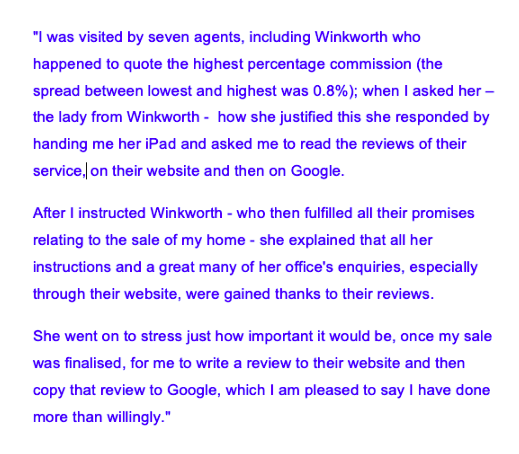
Factually inaccurate reviews and potentially misleading reviews: these categories of reviews have the capacity to prevent consumers even enquiring about your services. Here's more on this important subject.


The snag? You will have to invite and display reviews on your own website. But is that really a snag, given that your potential customers relish seeing them there?


5.  Why is compliance so important (all our competitors seem to be flouting the law)?

The CMA is on the warpath against businesses that flout its core rules...

  • No cherry picking (selecting 'happy' customers to write reviews)
  • No gating (pre-qualifying 'happy' customers using a survey or similar mechanism)
  • No controlling the timing of the review
And if that is not reason enough: if you do flout these rules - as many businesses still do - it will be as obvious as night follows day to your competitors. And you don't want them saying 'I know XYZ has great reviews, but they're breaking the law to look that good' do you?

6.  Can we be sure of making money from adopting review management?

For years our response had to be 'Why don't you try it and see?'. Not any more. Hard evidence is now available - monthly - from your Google my Business report. 


Every business gets a GMB report monthly. This one was sent to us by a client after their first full month of active membership. The figures in green are our focus.

And this anecdote - from a client of a client of ours - really says it all...


If you have any more questions, don't hesitate to ask. Or you can interrogate the nearly 1,000 articles on this blog - but we'd far rather speak to you in person.